

TOPCon Solar Panels – The Future of Solar for Homes & Businesses
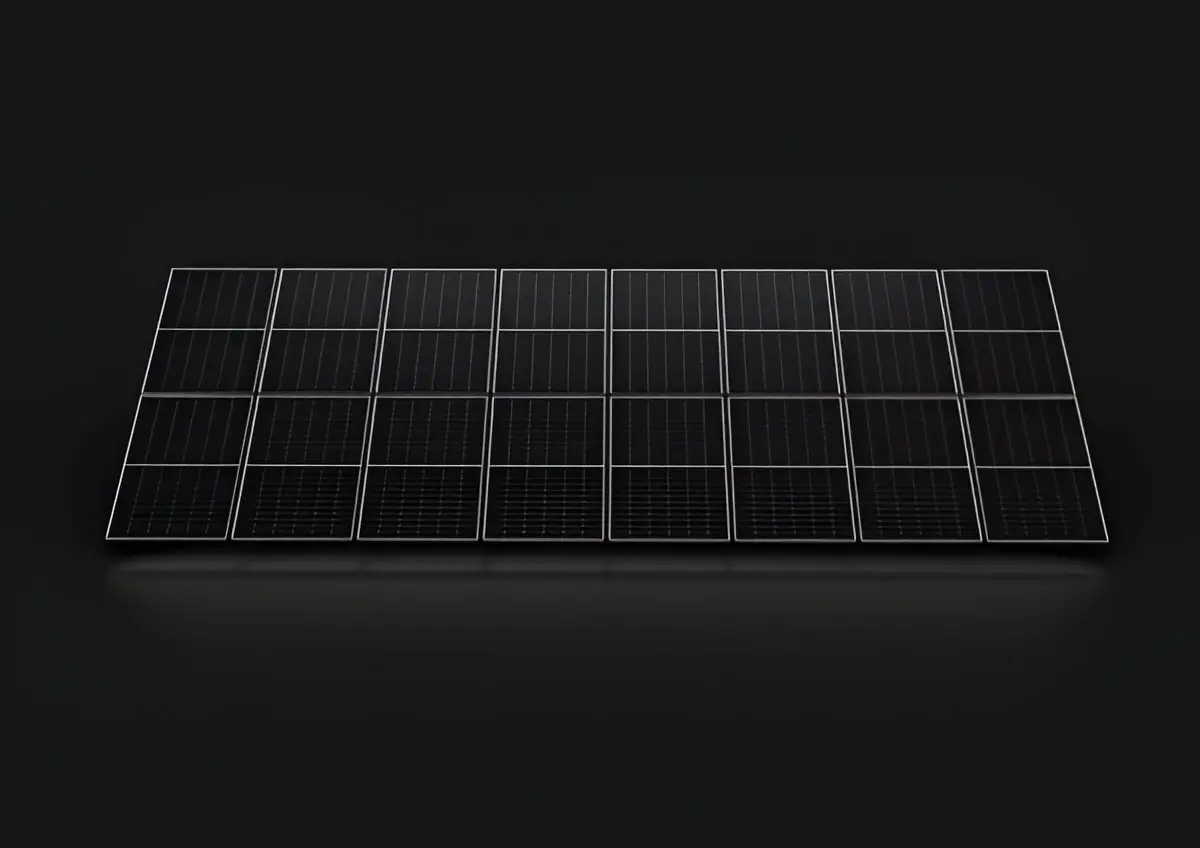


Solar panels have certainly evolved fast, starting from early polycrystalline modules to the Mono PERC, and with TOPCon. Each and every leap has squeezed more electricity from the same sunlight, further making systems cheaper per unit of energy and made them more reliable on rooftops.
In 2025, TOPCon (Tunnel Oxide Passivated Contact) will stand out for its higher efficiency, stronger low-light performance, and longer lifespans when compared to the previous generation of solar panel types.
Keep reading as we highlight the importance of investing in a TOPCon type of solar panel installation on your home or in a commercial place today, along with its set of benefits, maintenance tips, and more.
What is TOPCon Technology?
At cell level, TOPCon does add upon an ultra-thin tunnel oxide and a doped polysilicon passivated contact on n-type silicon. This kind of structure helps in reducing electron recombination (wasted energy) and further helps the electrons to flow out of the cell even more easily, boosting conversion efficiency without changing the module’s manufacturing lines.
In real world practice, many PERT or PERC lines can be easily upgraded to TOPCon with limited extra equipment.
Why this matters: Experiencing less loss inside the cell is equal to generating more power from the same area, achieving better performance in low light, and less light-induced degradation typical of p-type cells.
Key Benefits of TOPCon Solar Panels
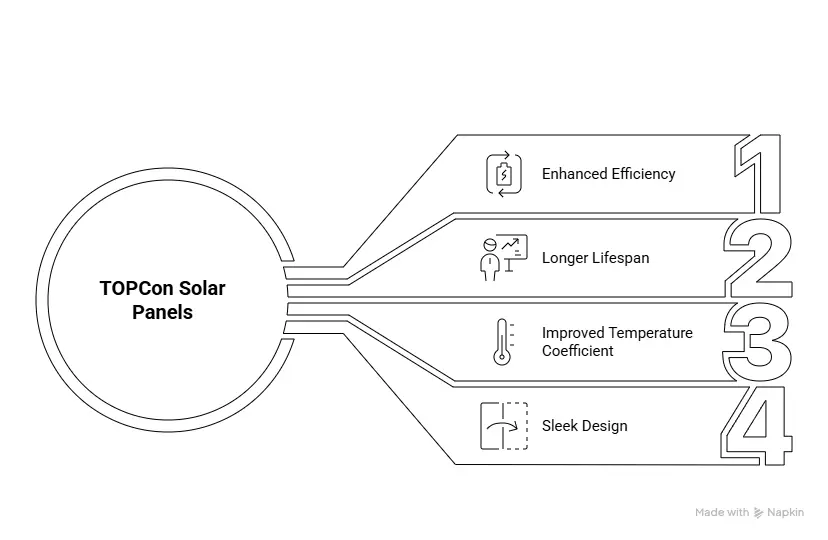
- High efficiency: Commercial TOPCon modules most commonly target about 22%, 23%, or even more efficiency at module level, well ahead of the mainstream Mono PERC. Higher efficiency does directly reduce the required roof area for the given output.
- Lower degradation: N-type of TOPCon helps reduce LID or PID risks, further letting the output stay steadier across decades. Reputed vendors like us do specify lower annual degradation when compared to PERC.
- Hot & cloudy resilience: The architecture’s lower recombination and the typical temperature together help operating in warm, humid climates and even during monsoon-style cloud cover.
- Superior low-light yield: TOPCon does show stronger mornings or evenings and overcast performance, which is highly useful for homes that remain shaded most part of the day.
- Bifacial options: Many of the TOPCon panels do come in bifacial variants that tend to harvest the reflected light from the rear side to achieve extra yield on bright surfaces.
- Longer service life: With robust passivation and n-type cells, the TOPCon is well-positioned for 30 years and even more, given its useful life under good O&M.
- Space efficiency: More watts per square metre helps when the roof space is tightly positioned, which is quite common in cities and in small commercial terraces.
TOPCon vs. Conventional Panels (PERC, Mono PERC)
| Feature | TOPCon | PERC/Mono PERC |
| Typical module efficiency | 22% to 23.5% | 19% to 21.5% |
| Lifespan (useful) | 30+ years | 25 to 30 years |
| Annual degradation | 0.25 to 0.4% per year | 0.45 to 0.6% per year |
| Low-light or Bifacial | Superior | Moderate |
How it matters in the real world:
- Higher savings: More generation from the same footprint helps speed up the payback timeframe.
- Faster ROI: Better morning or evening yield helps improve the kWh you tend to offset from the grid.
- Better use of the limited roof space: Ideal choice for apartments, villas hosting small terraces, shops, and SMEs.
TOPCon Applications: Homes & Businesses
- Homes: Great choice for rooftop solar where space is limited and bills said to be rising; higher efficiency here means fewer panels used for the same output.
- Commercial buildings or SMEs: Daytime loads do align well with solar generation; and TOPCon’s efficiency plus bifacial gain further amplify savings on flat RCC roofs and on carports.
- Solar farms or high-albedo sites: Bifacial TOPCon over light surfaces (tiles, white roofs,, or reflective ground cover) do help deliver meaningful extra kWh.
- Policy fit: Suitable choice for net metering programs where surplus exports are used to earn credits, improving the economics for prosumers. (See Kerala or KSEB’s description to better understand how exports offset imports on bills.)
Our in-house team of solar panel installers will provide end-to-end assessment approval, maintenance services, further helpful for you to adapt with the newer high-efficiency modules.
Cost, ROI & Lifespan (India-focused)
Current Price Range per Watt in India
- Market retail for high-efficiency modules or kits does sit anywhere between ₹28 to ₹40 per watt, based on the brand choice and bifacial glass.
- For residential rooftop EPC installation, the price might be around ₹50,000 to ₹60,000 per kW for 1 to 5 kW systems. These numbers must be treated as an example, and actual quotes will be generated by our team of solar experts, given your site, brand, and usage choice.
System-Wise Cost Examples (Before and After Central Subsidy)
MNRE PM Surya Ghar slabs for residential is ₹30,000 per kW up to 2 kW and ₹18,000 per kW for the next 1 kW, to a max of ₹78,000 subsidy as per the national portal. Benchmarks for the subsidy starts from ₹50,000 per kW for the first 2kW, and then ₹45,000 per kW for additional kW.
- 1 kW: Benchmark EPC is ₹50,000, and subsidy is ₹30,000, together calculated to a net of ₹20,000.
- 3 kW: Benchmark EPC is ₹1,45,000 (50k + 50k + 45k), and subsidy is ₹78,000, together calculated to a net of ₹67,000.
- 5 kW: Benchmark EPC is ₹2,35,000 and subsidy is capped at ₹78,000, together calculated to a net of ₹1,57,000.
The state add-ons or the DISCOM incentives can be further applied where applicable, reducing the overall net cost.
Factors Driving the Cost Up or Down
Brand and module tech, bifacial glass builds, BIS or ALMM compliance, racking quality, inverter type, and monitoring together affect the investment cost.
Expected Annual Generation and Savings (Possible Ways to Estimate)
The typical India-based specific yield is around ₹1,400 to ₹1,800 kWh per year (based on location or tilt dependency). Make use of your electricity tariff to convert kWh into actual Indian Rupees based savings.
- For example: at 1,6000 kWh or kW per year, and ₹7 per kWh, the 1kW investment will further save ₹11,200 per year; 3kW as ₹33,600 per year; and 5kW a s₹56,000 per year.
Our solar team experts will help you calculate the investment cost and savings based on the state tariff to attain a precise figure.
Indicative Payback Periods (Post-Subsidy)
- According to a research report released by Institute for Energy Economics and Financial Analysis states the residential payback time most commonly falls under the 3 to 6 years range or 8 years (based on tariff, site, and shading dependent).
Lesser unit consumption directly translates to lesser cost savings, especially when those units are replaced by solar.
Warranty Coverage – Product vs. Performance
- Product (workmanship) warranty: Mostly 12 to 15 years warranty is provided, and some premium n-type lines do extend it to 25 years.
- Performance (linear power) warranty: n-type of TOPCon often mentioned 30 years with 0.4% per year max degradation post usage after year 1. (For example – 99% in year 1, 87% to 88% by year 30).
Our solar experts will help in analyzing the brand and other various factors to determine the degradation percentage.
Installation & Maintenance Tips
- Roof space: As a planning thumb-rule, 80 to 120 sq ft per kW is recommended based on chosen panel wattage and tilt. Higher-efficiency TOPCon helps in shrinking such requirements.
- Professional solar panel installation matters: Finding the right tilt, space, inverter size, and cable routing will help protect yield (especially for bi-facial that need reflective surfaces and shading control). Ensure to reach out to our team of solar panel installers who have proven local approval experiences to handle the installation and verification process professionally.
- Basic O&M: Quarterly cleaning done in dusty seasons, routine visual checks for hot spots or cable wear, and annual electrical inspections done will help keep output on track.
We do offer preventive maintenance plans customized to meet your regular maintenance needs.
Environmental Impact
TOPCon’s higher output and longevity directly translates into greater carbon footprint reduction. Over 30 years of run time, a 5 kW rooftop system can certainly offset more than 12 tons of CO2, which is equivalent to planting about 5,000 trees.
Its higher efficiency and slower degradation lets each panel produce more cleaner energy per kilogram of material, further maximizing carbon footprint reduction.
TOPCon modules tend to last longer than older PERC panels, and they delay waste generation, reducing the need for manufacturing replacements. This kind of extended lifecycle supports India’s net zero and renewable energy goals.
How to Choose the Right TOPCon Panel
- In India, always look for BIS compliance and ensure to hire services from vendors as included in MNRE’s ALMM (Approved List of Models & Manufacturers)
- Compare efficiency and warranty sheets is a must. Always prefer higher nameplate efficiency, stronger first-year and linear degradation terms.
- Consider bifacial models, especially if your site offers reflective ground or roof finishes. Bifacial TOPCon can add meaningful rear-side gain, our installation team will model it accordingly.
- Ensure your installer confirms eligibility for rooftop solar subsidies and state net metering caps or rules.
Our team of solar experts will better understand your TOPCon panel installation needs, visit your site, evaluate, and then derive the exact investment, system placement, and applicable subsidies.
Frequently Asked Questions (FAQs)
1. What does TOPCon mean and how is it different from PERC?
TOPCon utilizes a tunnel oxide and polysilicon contact upon n-type silicon to reduce electron loss. This further produces higher efficiency and lower degradation when compared to PERC.
2. How much more power can TOPCon generate?
Most usually 8% to 12% more output gets generated per square metre than the standard PERC, and it does vary based on location and weather.
3. Are TOPCon panels eligible for subsidies?
Yes, if the panels or ALMM or MNRE approved and the project is rightly registered in the national rooftop portal.
4. What’s the payback period for homes?
The payback period for homes is anywhere between 4 to 6 years, or 8 years, based on electricity tariffs and accumulated sunlight hours.
5. Can TOPCon work on small roofs or partial shade?
Yes, their higher efficiency and low-light tolerance together make them an ideal choice for compact roofs or urban areas.
6. How often do TOPCon panels need maintenance?
Quarterly cleaning is highly recommended in most regions, and professional service must be done once a year to achieve better output and prolong the system’s run time capacity.
7. Are there bifacial variants, and what is bifacial gain?
Yes. Rear-side illumination can certainly boost the total output by 10% to 30% based on the site conditions.
Conclusion
TOPCon panels do represent the future of rooftop solar for both homes and businesses, delivering slower degradation, superior efficiency, and higher lifetime returns. By adopting this technology, you are about to lock in decades of savings and lower carbon emissions to your investment done on them.
At El Sol Power Solutions, the most reliablesolar company in India, we bring in global solar innovation to your residential or commercial space, offering on-grid system integration, custom designs, and ongoing support customized to your surrounding climate and policies.
Our expert help will make your journey to clean energy more transparent, simple, and profitable.


