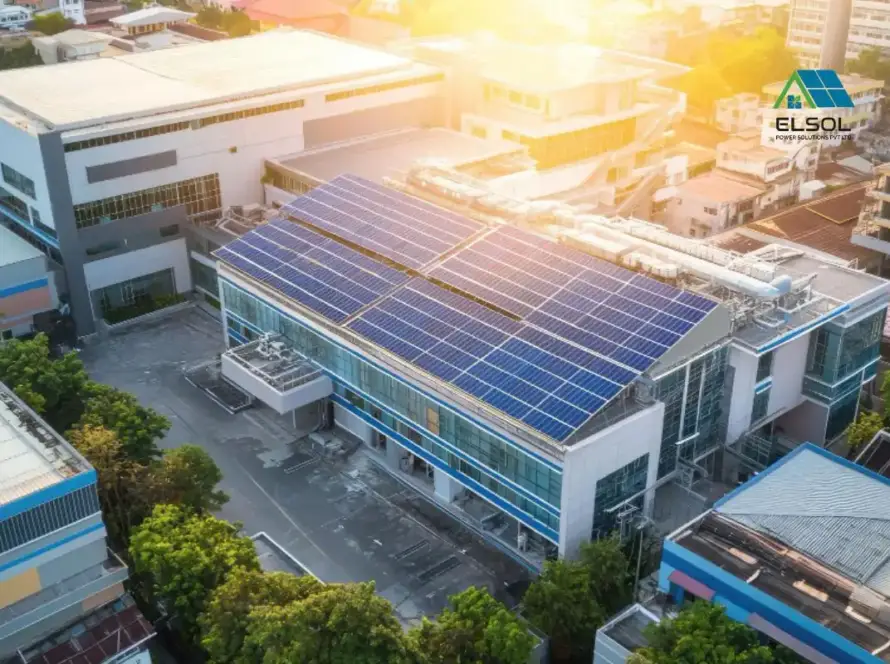
Benefits of Using Solar Power in the Industrial Sector
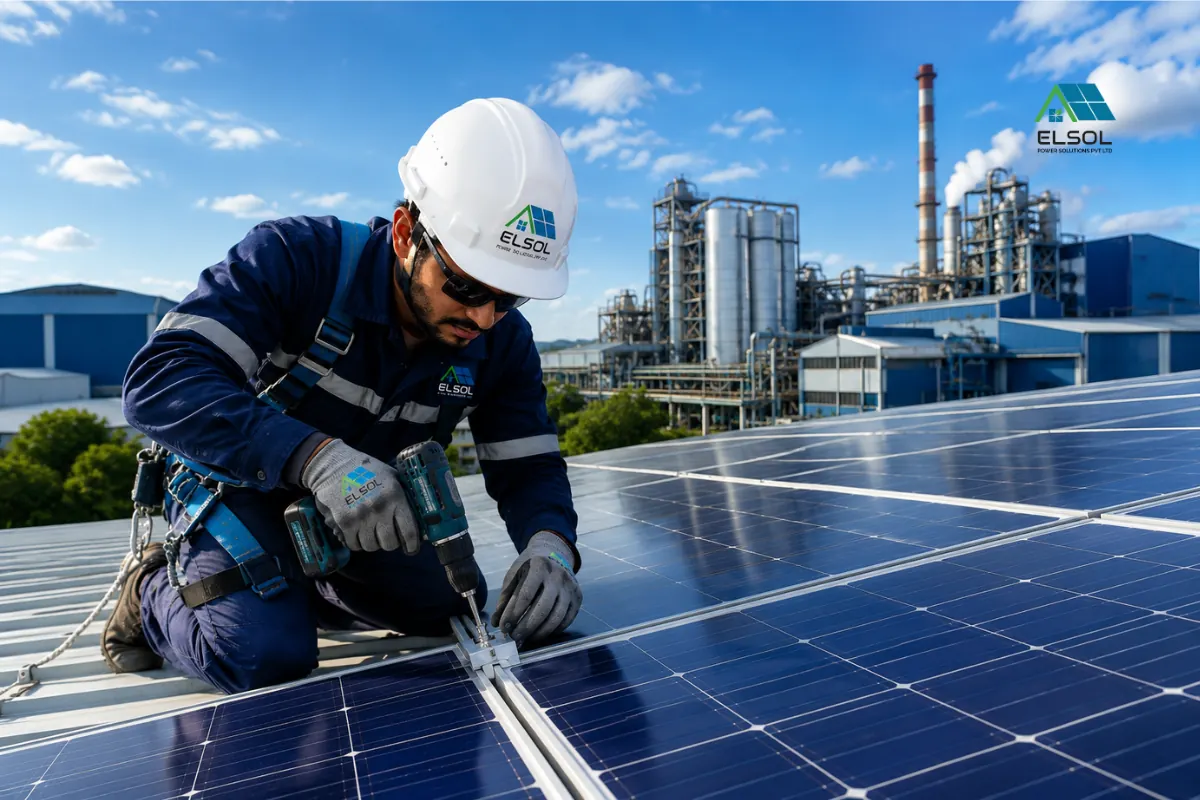


Solar power in industries cuts electricity bills by 50-80%, locks in energy costs for 20-25 years, and improves energy security by reducing grid dependence. It lowers carbon emissions, qualifies factories for accelerated depreciation benefits, and boosts your brand value with solid ESG credentials.
As of April 2026, India’s total installed solar capacity has crossed 154 GW, and industrial units are a big reason for that number.
If your factory is still running entirely on grid power, this blog will show you exactly what you’re leaving on the table.
Why Indian Industries Are Switching to Solar Right Now
Electricity is one of the biggest costs your factory deals with every month.
In India, industrial electricity tariffs currently run between Rs. 6 and Rs. 15 per unit depending on the state – and they’ve been climbing consistently. Tamil Nadu hiked industrial tariffs to Rs. 7.5/unit in FY 2026, and UP is proposing a further 15-18% industrial tariff hike for FY 2026-27. Industrial power tariffs remain volatile and generally trend upward in many states, which is why more factories are evaluating solar as a long-term cost-control strategy.
Solar tells a completely different story.
India installed a record 44.6 GW of solar capacity in FY 2026 – an 87.2% jump over the previous year. The first quarter of 2026 alone added 15.3 GW, the highest quarterly addition ever recorded in the country. India’s total solar capacity now stands at 154 GW as of April 2026, with solar accounting for 28% of India’s total installed power capacity.
The global weighted average LCOE of utility-scale solar PV fell from about $0.417/kWh in 2010 to about $0.043/kWh in 2024. That’s a 90% reduction in 14 years. For your factory, the math is simple. Grid power keeps getting expensive. Solar keeps getting cheaper. Every month you delay, that gap costs you money.
Open access solar projects contributed 21% of all large-scale additions in Q1 2026 – driven directly by commercial and industrial buyers who are done paying high grid rates. The shift is well underway. The only question is whether your plant joins it now or later.
India’s Industrial Solar Landscape: Live 2026 Data
| Metric | Latest Figure |
|---|---|
| India’s total solar capacity (April 2026) | 154.24 GW |
| Solar added in FY 2026 (full year) | 44.6 GW – all-time record |
| Solar added in Q1 2026 alone | 15.3 GW – highest quarter ever |
| Total rooftop solar installed (2026) | 26.75 GW+ |
| Rooftop solar added in FY 2026 | 8.7 GW (69% YoY growth) |
| Solar’s share of India’s total power capacity | 28% |
| Solar’s share of renewable energy capacity | 55% |
| Open access share of large-scale additions (Q1 2026) | 21% |
| India’s total renewable energy capacity (March 2026) | 275 GW |
| Global solar LCOE (2024) | $0.043/kWh |
| India’s solar target by 2030 | 280 GW |
Sources: Mercom India Q1 2026 Report, JMK Research FY2026, SolarQuarter May 2026, PV Tech May 2026
8 Real Benefits of Solar Power for Industrial Units
1. Your Electricity Bills Drop – Fast
This is the benefit most factory owners notice first, and the numbers are hard to argue with.
Your factory is currently paying Rs. 7-12 per unit to the state DISCOM – and that rate goes up almost every year. A solar installation delivers power at an effective cost of just Rs. 1.5-3 per unit over its lifetime, once the system is paid off.
For a factory consuming 50,000 units a month, that’s a potential saving of Rs. 2.5-5 lakh every single month.
Here’s how it plays out across the system’s life:
- Break-even on your investment happens in 4-6 years
- The next 19-21 years deliver near-free electricity
- Total lifetime savings can easily cross Rs. 5-10 crore for a mid-sized plant
Rooftop solar panel installation on your existing factory building uses idle roof space – no land acquisition needed. Many industrial units report their annual electricity bill falling by 50-70% in the very first year of going solar.
2. You Stop Worrying About Tariff Hikes Every Year
Grid tariffs change every financial year. Solar costs don’t.
Once your panels are installed, the cost of generating power stays nearly flat for 20+ years. You’re not exposed to annual DISCOM revisions, fuel surcharge increases, or transmission costs that keep getting passed down to industrial consumers.
Consider this: Tamil Nadu raised industrial tariffs from Rs. 7.25 to Rs. 7.5/unit for FY 2026. UP is proposing a 15-18% hike for industrial consumers in FY 2026-27. Factories that already have solar barely noticed either announcement.
How the savings gap grows over time:
| Year | Grid Rate (Rs./unit) | Your Solar Cost (Rs./unit) | Savings per Unit |
|---|---|---|---|
| 2026 | Rs. 8.50 | Rs. 2.50 | Rs. 6.00 |
| 2028 | Rs. 9.50 (est.) | Rs. 2.50 | Rs. 7.00 |
| 2031 | Rs. 11.00 (est.) | Rs. 2.50 | Rs. 8.50 |
| 2035 | Rs. 13.00 (est.) | Rs. 2.50 | Rs. 10.50 |
Grid projections based on historical tariff trends. Solar cost assumes system paid off after Year 5.
Every year you wait, the savings gap gets wider.
3. Strong Financial Incentives Built for Industrial Buyers
The financial case for going solar isn’t just about lower bills. There are concrete tax and policy advantages your business can access right now. Here’s what’s available to industrial units in 2026:
- 40% Accelerated Depreciation – Claim 40% of your solar system value as depreciation in Year 1 under the Income Tax Act. This directly reduces your taxable profit and typically cuts the effective system cost by 25-30%.
- Open Access Policy – If your factory has a sanctioned load or contract demand of 100 kW or more, green open access may be available, subject to state regulations, applicable charges, and project economics. Open access contributed 21% of all large-scale additions in Q1 2026.
- Net Metering – Excess power your panels generate gets credited against your grid consumption. Your meter effectively runs in reverse during high-generation hours.
- GST Input Credit – As a GST-registered business, your eligibility to claim input tax credit on a solar installation depends on the project structure, invoicing, and applicable tax treatment, so it should be reviewed with your tax advisor before finalising the project.
These benefits are available today. Policy environments shift as adoption grows, and factories that lock in their systems now will hold advantages that latecomers won’t.
4. Power Cuts Stop Costing You Production Time
Grid outages cost Indian industries anywhere from Rs. 40,000 to Rs. 1.2 lakh per hour in lost production, depending on the sector. Voltage fluctuations damage equipment. Grid reliability is uneven across states.
Solar – especially when paired with battery storage or DG backup – gives you a far more stable energy supply. Factories that have switched report:
- Fewer production stoppages from grid failures
- Less equipment damage caused by voltage spikes and fluctuations
- Better production planning because power availability becomes predictable
In 2026, Rajasthan (32% of cumulative large-scale solar), Gujarat (21%), and Karnataka (11%) lead in installed solar capacity and also offer the strongest open-access frameworks for industrial buyers. If your plant is in any of these states, the infrastructure and policy support are already in your favour.
5. Your Carbon Footprint Comes Down – and That Has Real Business Value
Solar energy globally avoided 1.5 billion tonnes of CO2 in 2025 alone, according to the IEA’s Global Energy Review 2026. India’s contribution to that number is significant – and growing fast. For your factory specifically:
- Every 1 MW of solar installed offsets around 1,400-1,600 tonnes of CO2 per year
- A 500 kW rooftop system cuts roughly 700 tonnes of CO2 annually – equivalent to planting about 32,000 trees
- Coal-based electricity in India emits 0.82 kg of CO2 for every kWh it produces. Solar emits zero during operation.
But this isn’t just about environmental credentials. In 2026, carbon reduction is a hard business number.
The Carbon Border Adjustment Mechanism (CBAM) is rolling out across European markets. For export-oriented manufacturers, especially those supplying sectors covered by or linked to the EU’s Carbon Border Adjustment Mechanism, lower electricity-related emissions are becoming increasingly important for long-term competitiveness and compliance. India’s 2026 Union Budget also allocated $2.2 billion for carbon capture and storage across five high-emission industries: power, steel, cement, refineries, and chemicals.
If your sector is on that list, going solar today puts you ahead of compliance requirements that are only going to get stricter.
6. Your Factory Roof Is Already There – Put It to Work
Many industrial buildings have large rooftop areas that can potentially be converted into productive energy assets, subject to structural suitability, shading conditions, and layout constraints.
Rooftop solar panel installation turns that dead space into a 25-year power asset – with zero additional land required. India’s cumulative rooftop solar capacity has now crossed 26.75 GW in 2026, up from 20.8 GW at the end of 2025. That’s factories, warehouses, and commercial buildings converting idle roofs into productive infrastructure.
Here’s a rough estimate of what your roof can support:
- 1,000 sq. meters – supports around 100-130 kW of solar
- 5,000 sq. meters – supports 500-650 kW
- 10,000 sq. meters – can host 1-1.3 MW of solar panels
Industries with strong rooftop solar potential include:
- Textile mills – large shed roofs, consistent daytime energy demand
- Cold storage and food processing – high refrigeration loads that align with solar generation hours
- Auto component manufacturers – assembly lines running day shifts
- Pharmaceuticals – HVAC and cleanroom loads, sustainability reporting requirements
- Ceramics and chemicals – energy-intensive continuous operations
Your roof is already paid for. The only question is whether it’s earning for you.
7. Solar Is a Capital Asset That Keeps Paying You Back
Unlike monthly electricity bills that disappear the moment you pay them, a solar system is a depreciating capital asset on your balance sheet.
You claim 40% accelerated depreciation in Year 1. The system continues delivering savings for 25+ years after it’s fully written off. Banks increasingly treat solar installations as positive collateral when you apply for business loans.
For any CFO looking at capital decisions, it’s genuinely difficult to find another investment that combines a 4-6 year payback, a 25+ year operating life, and substantial Year 1 tax benefits in a single package.
8. Your Brand Value Rises – with Buyers, Banks, and Talent
In 2026, sustainability is a business requirement, not a nice-to-have. Companies with documented green credentials are:
- Winning more tenders where ESG scores now factor into vendor evaluation
- Attracting stronger talent – younger professionals actively choose employers who invest in clean energy
- Accessing better financing – green loans and preferential lending terms for businesses with renewable energy investment are increasingly common
- Building stronger global buyer relationships – international brands need to hit their own net-zero targets and they source from suppliers who help them get there
India’s 2026 policy direction clearly supports clean energy and industrial decarbonisation, while residential rooftop solar has separately continued to receive large-scale financial support under PM Surya Ghar. Factories that move now are positioning themselves exactly where policy, finance, and global trade are all heading.
Which Industries Benefit Most from Solar in India?
| Industry | Primary Benefit | Typical System Size |
|---|---|---|
| Textile & Garments | Large roof space, high daytime load | 200 kW – 5 MW |
| Auto & Auto Components | Day-shift alignment, open access | 100 kW – 2 MW |
| Food Processing & Cold Storage | Refrigeration loads, 24×7 savings | 500 kW – 3 MW |
| Pharmaceuticals | HVAC loads, ESG compliance | 200 kW – 2 MW |
| Chemicals & Plastics | High energy intensity, process heat | 500 kW – 5 MW |
| Ceramics & Glass | Kiln operations, continuous load | 1 MW – 10 MW |
| Steel & Metal Fabrication | Furnace offset, open access solar | 1 MW – 20 MW |
| Cement | Extreme energy intensity, large land | 5 MW – 50 MW |
Three Ways to Go Solar as an Industrial Unit
Not every factory has the same capital position. Here are the three main models available to industrial buyers in 2026.
CAPEX Model – You Own the System
You buy and own the solar system outright. You get the full accelerated depreciation benefit and maximum long-term savings. Best if you have available capital and a clear 5+ year horizon at your current facility.
OPEX / PPA Model – Zero Upfront Cost
A developer installs solar on your premises at no cost to you. You pay a fixed per-unit rate – typically 20-40% below your current grid rate – from Day 1. No capital outlay, immediate savings, no ownership responsibility. Ideal if cash flow is your priority.
Open Access Solar – Buy from a Remote Plant
You procure renewable energy from a solar plant elsewhere and receive it via the grid. This model is legally available to eligible consumers from 100 kW under the Green Open Access framework, though it is often more practical for larger consumers depending on state charges, load profile, and project size. In Q1 2026, open access accounted for 21% of all large-scale solar additions – showing just how much industrial demand is moving this way.
What to Check Before You Sign Anything
Before you commit to any solar panel installers or finalize a proposal, verify these points first:
- Shadow-free roof area – panels need clear sunlight for at least 5-7 hours a day
- Roof structural load capacity – solar panels typically add 15-20 kg per sq. meter
- Your sanctioned load and contract demand with the DISCOM
- Net metering eligibility in your state – policies vary significantly
- Open access regulations if you’re considering systems above 100 kW
- Panel quality – insist on Tier-1 panels with 25-year linear performance warranties
- Installer track record – ask for completed industrial project references, not just brochures
The cheapest quote is rarely the cheapest system. A poorly installed solar system underperforms for its entire 25-year life. Choosing the right solar panel installers – ones with actual industrial project experience – is as important as choosing the right equipment.
Frequently Asked Questions
1. How much does a 1 MW industrial solar system cost in India in 2026?
A 1 MW rooftop solar system in India currently costs approximately Rs. 4-5.5 crore, depending on panel technology (mono vs. bifacial), inverter brand, and mounting structure. With 40% accelerated depreciation applied in Year 1, your effective post-tax cost typically comes down by 25-30%. Prices have stayed stable through 2025-26 as domestic module manufacturing capacity crossed 144 GW annually.
2. What is the payback period for industrial rooftop solar in 2026?
Most industrial rooftop solar installations achieve payback in 4-6 years. After that, you’re generating power at near-zero cost for the next 19-21 years. Annual O&M typically runs Rs. 3-5 lakh per MW, and quality systems require minimal intervention.
3. Can my factory sell excess solar power back to the grid?
Possibly, subject to your state DISCOM policy, sanctioned load, and the applicable net metering or net billing framework. Excess units you feed into the grid get credited against your future grid consumption. Rules vary by state – some states cap net metering capacity or restrict banking periods – so check your DISCOM’s current policy before finalizing your system design.
4. Does solar work for 24/7 factory operations?
Solar generates power during daylight hours – roughly 6-8 hours at full output per day. For factories running round the clock, solar offsets your entire daytime grid consumption while grid or DG backup covers night shifts. Hybrid systems with battery storage are increasingly practical for operations that need full-time energy security. India’s battery storage capacity is growing fast in 2026, bringing down hybrid system costs.
5. How long do industrial solar panels last?
Tier-1 panels carry 25-year linear performance warranties, guaranteeing at least 80% of rated output at Year 25. Most systems continue operating beyond 30 years, with gradual degradation of 0.5-0.7% per year. India’s domestic solar module manufacturing capacity hit 144 GW per year in 2025, meaning quality supply is no longer a concern.
6. Will installing solar affect my existing DISCOM connection?
No. Solar is installed in parallel with your existing grid connection. Your grid supply stays fully intact as a backup. The solar system reduces how much you draw from the grid – lowering your monthly bill with zero disruption to operations.
7. How much CO2 does a 500 kW industrial solar system save?
A 500 kW system generating around 7 lakh units per year offsets approximately 575-700 tonnes of CO2 annually, based on India’s grid emission factor of 0.82 kg CO2/kWh. That’s the equivalent of removing 125+ cars from the road every single year – and the kind of number that matters when global buyers ask for your Scope 2 emissions data.
8. Is rooftop solar suitable for leased factory premises?
It depends on your lease terms. Many businesses on leased properties use the OPEX/PPA model – since the developer owns the system, there’s zero capital risk for the tenant. Some landlords also invest in solar directly and structure the savings into lease arrangements. Either way, it’s worth a conversation before assuming it isn’t possible.
Ready to Make the Switch? El Sol Power Solutions Can Help
India added 44.6 GW of solar in FY 2026 – the most ever in a single financial year. Q1 2026 alone set the record for the highest quarterly addition at 15.3 GW. Industrial and commercial consumers drove 21% of large-scale additions through open access, specifically because factory owners are tired of paying grid rates when a proven alternative exists.
Grid electricity is not getting cheaper. In Tamil Nadu, industrial rates are already at Rs. 7.5/unit and climbing. In UP, a 15-18% hike is on the table for FY 2026-27. The factories that switched to solar two or three years ago are insulated from all of it.
El Sol Power Solutions works with industrial clients across India to design, install, and maintain solar systems built for real manufacturing environments. From site assessment and system sizing to DISCOM approvals, grid connectivity, and long-term monitoring – the team handles every step.
Whether you’re looking at rooftop solar for your existing plant, evaluating the OPEX model to avoid upfront costs, or exploring open-access procurement for a high-load facility – El Sol gives you honest guidance and a system built to last.
Trusted as one of the best solar companies in India for industrial and commercial projects, El Sol’s experienced solar panel installers bring the technical know-how and project track record that matter when your factory’s energy costs are on the line. Solar panel installation has never been more financially compelling. The grid isn’t getting any cheaper.