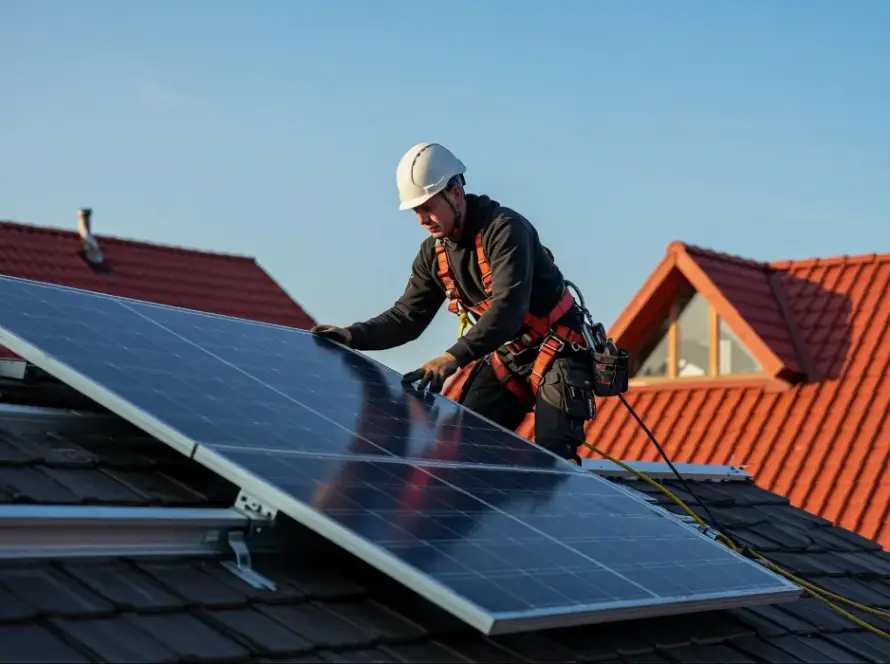
If you have been planning to switch to rooftop solar in Tamil Nadu, then you are in the right place. With rising electricity bills, strong government support and growing environmental concerns, now is the right time to act.
Tamil Nadu has been rapidly emerging as one of the top leaders in solar adoption. With favourable policies, abundant sunlight, and more and more homeowners and businesses turning to clean power, it’s quite clear that solar panels are more than a trend; it’s a smart investment.
Whether you are aiming to reduce your carbon footprint or replacing the costly grid electricity, installing solar panels on your roof does offer both environmental and financial benefits.
Keep reading as we walk through the key costs, subsidies you can avail, how net-metering works, and the possible ways to avoid common mistakes, so that you can make a confident investment decision.
Why Choose Solar Panels in Tamil Nadu?
High solar irradiance & ideal climate
Tamil Nadu does have strong exposure to sunshine almost most part of the year, further making rooftop solar systems productive and efficient. The more sun your panels can get, the quicker the payoff.
Progressive state & national policies
Tamil Nadu Policies or Regulations
- A draft regulation or final was issued in 2024, which proposed comprehensive rules governing grid interactive solar PV generating systems in Tamil Nadu, including net billing, net-metering, feed-in options, and various user categories.
Such regulations do specifically aim in streamlining the ways rooftop and other types of solar systems integrate with the grid in Tamil Nadu.
In 2025, the state government of Tamil Nadu has announced the formation of a panel to draft a comprehensive renewable energy policy that covers wind, solar, biomass, and pumped storage.
National Policies or Regulations
Under the PM Surya Ghar: Muft Bijli Yojana, which was launched in Feb 2024, the central government aims in benefitting rooftop solar installation all over the country. It does target about 1 crore households and includes subsidies that promise up to 300 free units of electricity monthly, for every eligible house.
This particular scheme is known for significantly lowering the barrier of households to adopt rooftop-solar, further making it easy to access and align with national renewable targets.
Financial & environmental benefits
By rightly installing solar panels, you can significantly cut down your electricity bills. On the other side, you will reduce your carbon footprint, further moving toward adapting to a greener living environment.
Our in-house team of solar panel installers are here to understand your installation needs, analyze and suggest the right state and central policy that can let you earn valuable credit out of sending back excessively generated electricity to the grid. We do help in applying for the net-metering policies that help in saving your investment as early as possible.
Breaking Down Solar Panel Installation Price
What drives the cost of a rooftop solar system? Here are some of the key factors:
- Panel type & efficiency – Bifacial, mono-crystalline panels cost more upfront but they tend to deliver higher output.
- Capacity (kW size) – A larger system will cost you more, but the cost per kW most often reduces.
- Inverter type – Premium inverters (string, micro-string) can cost more but enhance utmost reliability.
- Mounting & structural materials – Roof type (flat, sloped), height, access, structural reinforcement are known to affect your investment cost.
- Installation complexity – Orientation, shade, roof pitch, safety or labour-logistics, all add upon to your investment cost.
- Location & local labour or DISCOM regulations – In Tamil Nadu, grid approval or connection expenses matter.
2025 Price Range Table (Typical for Tamil Nadu, before subsidy)
Here’s an indicative price range for installing residential on-grid rooftop solar in Tamil Nadu before attaining subsidy.
| Capacity | Approximate Cost Before Subsidy |
| 1 kW | ₹90,000 to ₹1,30,000 |
| 2 kW | ₹1,40,000 to ₹1,80,000 |
| 3 kW | ₹1,90,000 to ₹2,30,000 |
| 4 kW | ₹2,50,000 to ₹2,90,000 |
| 5 kW | ₹2,90,000 to ₹3,30,000 |
| 10 kW | ₹5,40,000 to ₹5,80,000 |
*Above mentioned prices are indicative and can vary based on the various factors listed above.
Available Subsidy Schemes in Tamil Nadu
Central Government Subsidy (PM Surya Ghar Scheme)
Under this particular national scheme, residential homeowners are now eligible for solar installation subsidy upon choosing on-grid rooftop solar systems. For instance:
- 1 kW system: subsidy – ₹30,000
- 2 kW system: subsidy – ₹60,000
- 3 kW and above: subsidy – ₹78,000
Eligibility
The PM Surya Ghar scheme is open to all Indian citizens legally occupying or owning a residential property with a valid electricity connection. As an applicant you must have sufficient rooftop space for the panel installation and must not have availed other types of central subsidy for the same system. The subsidy does apply only to residential consumers.
Coverage
This particular program does target about 1 crore of households nationwide, further supporting rooftop-solar adoption to cut down electricity bills, enhance grid dependence, and limit carbon emissions. The eligible consumer might also get benefitted from the net metering and get up to 300 units of free electricity every month.
Disbursement Process
- As an applicant you must register on their official portal, and then select an MNRE-approved vendor like us to take forward the inspection and installation process.
- Once the DISCOM approval arrives and net-metering is set up, the subsidy gets directly credited to your beneficiary bank account through DBT.
- The overall process ensures utmost transparency and quick disbursal once the system gets commissioned.
State Subsidy
- Agriculture users: Farmers in Tamil Nadu can utilize the PM-KUSUM Yojana (central) and the state-level water-pumping or drying subsidies. Under this particular scheme, subsidy gets shared between the state and central (mostly 605 of the investment cost in many cases) with the farmer contributing to the remainder.
- Industry or Commercial users: Industrial units established in Tamil Nadu are eligible to apply under the Solar Power Project Scheme (TIIC) to attain 1 MW+ solar photovoltaic plants (over land or roof top).
- The Tamil Nadu state government also offers a domestic rooftop incentive of about ₹20,000 per kW for grid-tied rooftop-solar PV systems.
Solar System Size vs. Subsidy vs. Net Price
Here’s a roughly calculated estimate breakdown that combines cost, subsidy and net payable:
Net Metering in Tamil Nadu
What is Net Metering?
Net metering lets you send any size of surplus electricity your rooftop-solar system generates back to the grid itself, and receive valid credits or offsets upon your electricity bill.
How does it work in Tamil Nadu?
According to TNPDCL (Tamil Nadu Power Distribution Corporation Limited), for grid-connected rooftop systems:
Works on metering basis where the beneficiary pays to the utility based on the net metering reading, which is the difference between the import and export energy, given the rise in rise in imported energy. If the exported energy is more than the imported energy, then the utility will pay to the beneficiary for the net energy exported.
Procedure for Net Meter Application and Integration with the Grid
In Tamil Nadu, as a homeowner applying for net metering, you must register with the local DISCOM (TANGEDO) through their USRTP portal.
- Once the rooftop-solar panel installation is completed by an MNRE-approved vendor like us, you can further submit the net-metering request.
- TANGEDCO will further inspect your site, install a bi-directional meter, and then integrate the system with the grid.
- Once it has been commissioned, the imported and exported energy readings will determine your net bill under TNERC’s Grid-Interactive Solar PV Regulations 2024.
Financial and Practical Benefits
- Save on your electricity bills: You get to pay only for the net energy you have consumed post exporting excessive solar power to the grid.
- Earn energy credits: Surplus units as sent to the grid are credited against your future bills, further lowering overall costs.
- High return on investment: Most homeowners have recovered their installation costs within 4 to 6 years through savings.
- Increase property value: Homes with rooftop-solar systems tend to attract better market value.
- Energy independence: Reduces dependence on the grid electricity and rightly protects against potential tariff hikes.
- Supports sustainability: You play a part and contribute to Tamil Nadu’s renewable energy and carbon reduction goals.
Step-by-Step Process: How to Avail Subsidy and Install Solar Panels
Here’s a typical process that you can follow with our in-house solar experts when installing rooftop solar and availing subsidy in Tamil Nadu:
1. Registration on National Portal for Rooftop Solar
Register through the official portal (the USRP portal of Tamil Nadu Generation and Distribution Corporation Limited) to seek valid subsidies.
2. Application, Documentation & Vendor Selection
- Choose an MNRE-approved vendor
- Submit the desired application form with other required documents like identity proof, roof details, electricity bill, and sanction load.
- Our experts will help you fill the technical details on your behalf.
3. Site Visit, Quotation and Technical Feasibility
- Our in-house team of expert installers will visit your place, inspect the roof areas for potential orientation and shading.
- They will prepare a quotation based on the chosen equipment quality, system size, and your usage.
4. Approval, Installation and Net Metering
- Post attaining approval from TEDA or DISCOM, our in-house team of solar panel experts will begin the installation process.
- Post installation, we will help apply for bi-drectional net meter. The utility TANGEDCO will take forward and complete the inspection process.
5. Final Inspection and Subsidy Disbursement
- After commissioning, the respective subsidy amount will be credited.
- Maintain a timeline and checklist regarding the roof inspection date, sanction load settled, clearing shading map, and other documents in order.
This kind of well-structured approach done under the supervision of your solar panel experts will highly benefit from the attained subsidy and even optimize your investment.
Long-Term Benefits & Return on Investment
Payback period
In many cases, residential rooftop systems tend to pay back within 4 to 6 years, based on system size, electricity tariff escalation and usage.
Annual savings & asset value
Once installed, connected and used for long term like 4 to 6 years, you get to essentially generate free electricity for twenty to twenty five years with minor degradation. This can add upon value to your property and even shield you from the future tariff hikes.
Environmental impact
By switching to rooftop-solar, you are about to reduce reliance on fossil-fuel electricity, lower your carbon emissions, and even contribute to sustainable living.
Maintenance & Service Standards
To keep your rooftop solar system running smoothly and profitably for years, ensure to pay attention to:
- Cleaning: Solar panels need to be cleaned once every 15 to 30 days to remove bird droppings, dust, or debris that can reduce the system’s running efficiency by up to 15%.
- Inspection: Conducting a quarterly inspection of mounting structures, wiring, and inverter connections ensure the system runs smoothly.
- Professional servicing: Ensure to schedule an annual professional maintenance check to let the components meet with the safety and performance standards.
- Avoid DIY repairs: Always choose to consult with the installer or an MNRE-certified technician like our in-house team for technical issues.
Service Obligations of Vendors under Present Subsidy Schemes
- As an MNRE-approved vendor, we provide 5 years of free comprehensive maintenance under the PM Surya Ghar and the MNRE rooftop subsidy programs.
- We take responsibility for your system performance, perform regular preventive maintenance visits and even replace faulty components if found.
- Our expert technician team ensures your system remains grid-compliant and even helps with net-metering and inspection procedures.
- As a vendor, we do support our customers with warranty claims, remote monitoring, and subsidy documentation.
Common Mistakes to Avoid
- Not hiring services from an MNRE-approved installer – This can only lead to putting your investment at risk.
- Over or under-sizing your system needs – Incorporating the wrong size means either inadequate energy offset or unused capacity.
- Ignoring net-metering eligibility requirements – Without following the respective paperwork and system requirements, you might lose credits instantly.
- Choosing the cheapest option blindly – Low-cost options will only lead to yielding low quality and lower output with higher maintenance.
- Neglecting roof condition or shading – The roof area needs to be structurally sound and also free from major shading.
Frequently Asked Questions (FAQs)
1. What are the documents needed to apply for the solar subsidy?
You must submit documents related to identity proof, latest electricity bill, roof ownership or rental proof, sanction load certificate, and the vendor’s quotation.
2. How long does it take to get the subsidy amount credited?
TNPDCL (Tamil Nadu Power Distribution Corporation Ltd) has promised to release the subsidy amount within 15 days if the consumer and vendor completes the data entry and required documentation correctly.
3. How does net-metering save money in Tamil Nadu?
In Tamil Nadu, net-metering does help save money by letting households to export the excessively generated solar power to the grid, offset the energy consumption, and pay only for the net electricity used, further reducing the monthly bills significantly.
4. What’s the average payback period for solar installations?
Typically 4 to 6 years for well-sized residential systems, based on usage and tariff escalation.
5. Are there any additional state subsidies in 2025 for residential customers?
Yes, other than the central subsidy received under PM Surya Ghar, Tamil Nadu does have state-level frameworks that at times provide extra incentive of about ₹20,000, for eligible systems.
6. What should I do post installation for best performance?
Regularly monitoring the system output, cleaning the panels when found dusty, ensuring the inverter is working, and scheduling preventive service through your vendor must be done to achieve best performance.
Conclusion
Switching to rooftop solar in Tamil Nadu is more than just a good idea, its a smart choice. With the right equipment, system size, and installer, you can certainly harness the abundant sunshine, earn credits with net-metering, and reduce your electricity bills. The generous state and central subsidies with supportive policies have been helping break the barrier to entry into solar energy power generation.
At El Sol Power Solutions, the leading solar company in Kerala, we do offer end to end services, starting from site survey to installation, filling net-metering paperwork, reliable ongoing maintenance, and more. Our in-house team of experts continuous expertise in terms of rooftop solar ensures that your upcoming transition remains smooth and maximises returns.
Reach us out now to get a free assessment, and be ready to take your first step toward more cleaner and cost-effective power generation today.