

On-Grid vs Hybrid Solar Systems: Key Differences in Cost, Backup & Performance
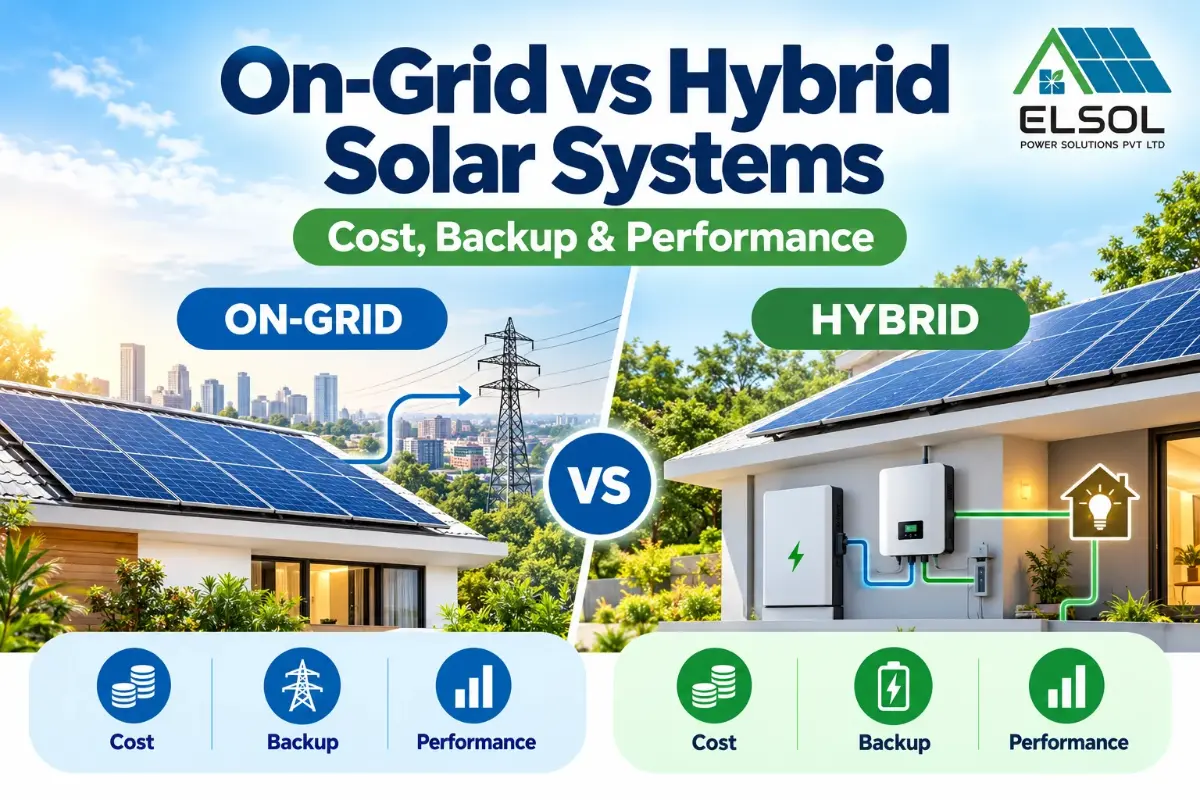


If you are evaluating a rooftop solar system in India in 2026, almost every installer will offer you two main choices: on-grid or hybrid. The right pick depends on three things: how reliable your local grid is, how much you are willing to spend upfront, and whether you need power during outages.
On-grid is cheaper and simpler. Hybrid gives you backup during power cuts and more independence from the grid. Both lower your electricity bill, but they do it in very different ways.
This guide walks through the actual cost differences, how each one performs, what happens during an outage, and which type of system suits which type of Indian home or business. All figures reflect current market pricing in 2026.
What Is an On-Grid Solar System?
An on-grid solar system is connected directly to your local electricity grid through a bi-directional net meter. Your solar panels generate DC power during the day, a grid-tied inverter converts it to AC, and that power flows to your home appliances first. Any surplus is exported to the grid, and the DISCOM credits your account under net metering.
When the sun is not shining or your load is higher than solar generation, you draw power from the grid as usual.
Key features:
- No battery
- Lower upfront cost
- Earns credits through net metering
- Shuts down during a grid outage for safety (an anti-islanding feature that protects utility workers)
- Standard choice under PM Surya Ghar Yojana
What Is a Hybrid Solar System?
A hybrid solar system combines three energy sources: solar panels, a battery bank, and the grid. A hybrid inverter manages the flow between all three.
During the day, solar powers your home first, then charges the battery, and finally exports surplus to the grid under net metering (where state policy allows). During a power outage, the hybrid inverter disconnects from the grid, continues to run on solar and battery, and keeps your critical loads supplied.
Key features:
- Battery storage (lithium-ion is the typical 2026 choice)
- Hybrid inverter with grid-interactive switching
- Backup power during grid outages
- Higher upfront cost
- Can still participate in net metering in most states
Core Differences at a Glance
| Factor | On-Grid Solar | Hybrid Solar |
| Battery | None | Required (typically 5 kWh for a 5 kW system) |
| Grid connection | Required | Required, with grid-interactive switching |
| Operation during outage | Shuts down | Continues on battery and solar |
| Net metering | Yes, standard | Yes, with export-limited settings in some states |
| 5 kW system price (after PM Surya Ghar subsidy) | Rs. 3,18,000 | Rs. 4,90,000 |
| PM Surya Ghar subsidy | Yes (up to Rs. 78,000 for 3 kW+) | Yes, but only on the solar PV portion |
| Maintenance | Simple (panels, inverter, meter) | More involved (battery health checks, inverter) |
| Payback period (post subsidy) | 4 to 6 years | 7 to 9 years |
Cost Breakdown: On-Grid vs Hybrid in 2026
Pricing varies by panel type, inverter brand, battery chemistry, and installation complexity. Below are typical 2026 after-subsidy prices for a complete rooftop solar installation.
5 kW On-Grid System
- Includes panels, grid-tied inverter, mounting structure, cables, protection equipment, installation, and commissioning
- After PM Surya Ghar subsidy: approximately Rs. 3,18,000
5 kW Hybrid System
- Includes panels, hybrid inverter, lithium-ion battery, mounting, cabling, protection, installation, and commissioning
- After PM Surya Ghar subsidy: approximately Rs. 4,90,000
The battery and hybrid inverter together add roughly Rs. 1,72,000 to the cost of a 5 kW hybrid system in 2026 compared to an on-grid system of the same capacity. That is the single biggest reason for the price gap, and it is the main factor homeowners weigh against the value of outage backup.
Important note on subsidy: As of 2026, PM Surya Ghar covers only the solar PV portion of your system. The battery is not separately subsidised under the current scheme. There has been active discussion of extending the scheme to cover storage under a possible PM Surya Ghar 2.0, but nothing has been formally notified yet. Verify the current position at pmsuryaghar.gov.in before planning your budget.
Backup Capability: Where Hybrid Really Earns Its Price
This is where the two systems diverge most sharply.
On-grid during an outage: The grid-tied inverter detects the grid failure and shuts the system down immediately. This is a mandatory safety feature called anti-islanding protection. Without it, your inverter could back-feed power into dead utility lines and electrocute a lineman trying to repair the fault. In practice, this means your solar panels sit idle during a power cut, even on a sunny afternoon.
Hybrid during an outage: The hybrid inverter disconnects your home from the grid, maintains frequency and voltage on its own, and keeps the critical load panel energised using the battery and incoming solar. For most Indian homes, this means lights, fans, Wi-Fi router, television, fridge, and (depending on battery sizing) one air conditioner can keep running through a power cut.
How long does the battery last? A simple formula: Backup time (hours) ≈ battery capacity (kWh) × usable depth of discharge × inverter efficiency ÷ load (kW).
For example, a 5 kWh lithium battery at 90% usable capacity and 90% inverter efficiency, supporting a 1 kW load, gives roughly 4 hours of backup. The same battery with a 500 W critical load (lights, fans, router, fridge compressor cycling) can run for 7 to 8 hours.
Performance Comparison
Daytime generation: Both systems generate roughly the same solar energy per kW installed, assuming identical panels, orientation, and tilt. In India, a well designed 5 kW system typically produces 18 to 22 units per day during good months and 12 to 15 units during monsoon.
Export performance: On-grid systems export every unit of surplus during the day. Hybrid systems export only after the battery is full, so they typically export fewer units overall. In states with generous net metering tariffs, this slightly reduces the economic value of a hybrid system compared to on-grid.
Round-trip losses: Hybrid systems lose roughly 10% to 15% of the energy that passes through the battery (charging and discharging). On-grid systems do not have this loss.
Maintenance: On-grid systems have fewer moving parts and no battery to monitor. Hybrid systems need periodic battery health checks and firmware updates to the hybrid inverter. Over 10 years, hybrid systems typically require one battery replacement, usually in year 8 to 10.
Which System Is Right for You?
The honest answer depends on your situation. Here is a practical decision framework.
Choose on-grid solar if:
- Your area has reliable power (fewer than 15 outage hours per month)
- Your main goal is to cut your electricity bill as fast as possible
- You want the lowest upfront cost and fastest payback
- Your DISCOM has an active net metering policy
Choose hybrid solar if:
- Your area has frequent or extended power cuts
- You run critical loads that cannot afford interruption (home office, medical equipment, fridge in a commercial setup)
- You want long-term energy independence
- You are planning for a time-of-day tariff environment, where storing cheap daytime solar for expensive evening use will matter
A middle path worth knowing: Many homeowners in 2026 install an on-grid solar system now, with a battery-ready hybrid inverter instead of a basic grid-tied inverter. This adds about Rs. 20,000 to Rs. 40,000 to the upfront cost but makes it easy to add a battery later without rewiring the system. This is often the smartest choice for Kerala and other states where power cuts have reduced in recent years but have not disappeared entirely.
Common Mistakes to Avoid
A few recurring mistakes come up when buyers compare on-grid and hybrid systems:
- Buying hybrid for infrequent outages. If you lose power only during storms, a hybrid system’s cost often outweighs its benefit. An on-grid system plus a small UPS for critical loads is usually cheaper.
- Underestimating battery replacement cost. Lithium batteries typically last 8 to 10 years. Budget for one replacement during the 25-year system life.
- Oversizing the battery. A 10 kWh battery for a home that only loses power for 2 hours a day is capital tied up for nothing. Size the battery to real outage patterns, not worst-case fears.
- Ignoring state-specific net metering rules for hybrid. A few DISCOMs apply export limits to hybrid systems. Confirm this with your installer before signing.
- Mixing budget components with a hybrid design. A hybrid system is only as reliable as its weakest part. Cheap inverters and no-name batteries fail early and often.
How El Sol Power Solutions Helps You Choose
At El Sol Power Solutions, we start every project with a conversation about your actual electricity usage, your local outage pattern, and your budget. For many Indian homes, a well designed on-grid solar system is the right answer. For homes in areas with frequent power cuts, or for commercial setups that cannot afford downtime, hybrid makes genuine sense.
As a solar company in India with hands-on experience across Kerala and the wider South Indian market, our team sizes the battery (if any) to real usage data, not worst-case assumptions. We also design most of our installations to be battery-ready, so even an on-grid customer today can add storage later without starting over.
If you are weighing on-grid vs hybrid and want numbers specific to your rooftop and your DISCOM, our team is one phone call away for a free site survey and a comparison quote.
Frequently Asked Questions
1. Which is cheaper, on-grid or hybrid solar?
On-grid is significantly cheaper. A 5 kW on-grid system typically costs around Rs. 3,18,000 after subsidy, while a comparable hybrid system costs around Rs. 4,90,000 after subsidy. The battery accounts for most of the difference.
2. Can I convert my on-grid solar system to hybrid later?
Yes, if your installer uses a battery-ready hybrid inverter from the start. If a basic grid-tied inverter is used, you will need to replace the inverter when adding storage, which adds roughly Rs. 50,000 to Rs. 80,000 to the retrofit cost.
3. Does PM Surya Ghar subsidy cover hybrid solar systems?
PM Surya Ghar currently subsidises the solar PV portion of a hybrid system, up to Rs. 78,000 for 3 kW and above. The battery is not separately subsidised. Discussions about extending the scheme to storage are ongoing, so verify current rules at pmsuryaghar.gov.in before purchase.
4. Why do on-grid solar systems shut off during a power cut?
This is a mandatory safety feature called anti-islanding protection. It prevents your inverter from feeding power back into dead utility lines, which could electrocute a lineman working on the fault. Hybrid systems can safely stay running because they isolate your home from the grid during an outage.
5. How long does a solar battery last?
Lithium-ion batteries used in hybrid solar systems typically last 8 to 10 years with normal use. Most come with a performance warranty of around 10 years or 6,000 cycles, whichever comes first.
6. Is hybrid solar worth it for homes in Kerala?
It depends on your area. For parts of Kerala with frequent monsoon-season outages, a hybrid system (or at least a battery-ready design) often makes sense. For areas with reliable KSEB supply, on-grid with net metering usually offers faster payback.
7. What happens to my electricity bill with each system?
Both systems reduce your bill by generating your own power. An on-grid system typically cuts the bill by 70% to 90% through solar self-consumption plus net metering credits. A hybrid system delivers similar savings on a monthly bill, with the added value of uninterrupted power during outages.
Conclusion
On-grid and hybrid solar systems are not competing products so much as different answers to different problems. If your local grid is reliable, your main goal is bill savings, and your budget is sensitive, on-grid wins on cost and simplicity. If you lose power often, run critical loads, or want genuine independence from the grid, hybrid earns its higher price through outage backup and long-term flexibility.
A good solar panel installation starts with an honest conversation about your actual usage, your outage pattern, and your budget. The El Sol Power Solutions team is one phone call away to walk you through the real numbers for your home or business. We will show you both options side by side, so you can make the call with full information instead of a generic recommendation.
A rooftop solar system is a 25-year decision. Pick the one that fits your life, not the one that fits a brochure.


