

Solar Installation & Transformer Limits: What Every Homeowner Should Know
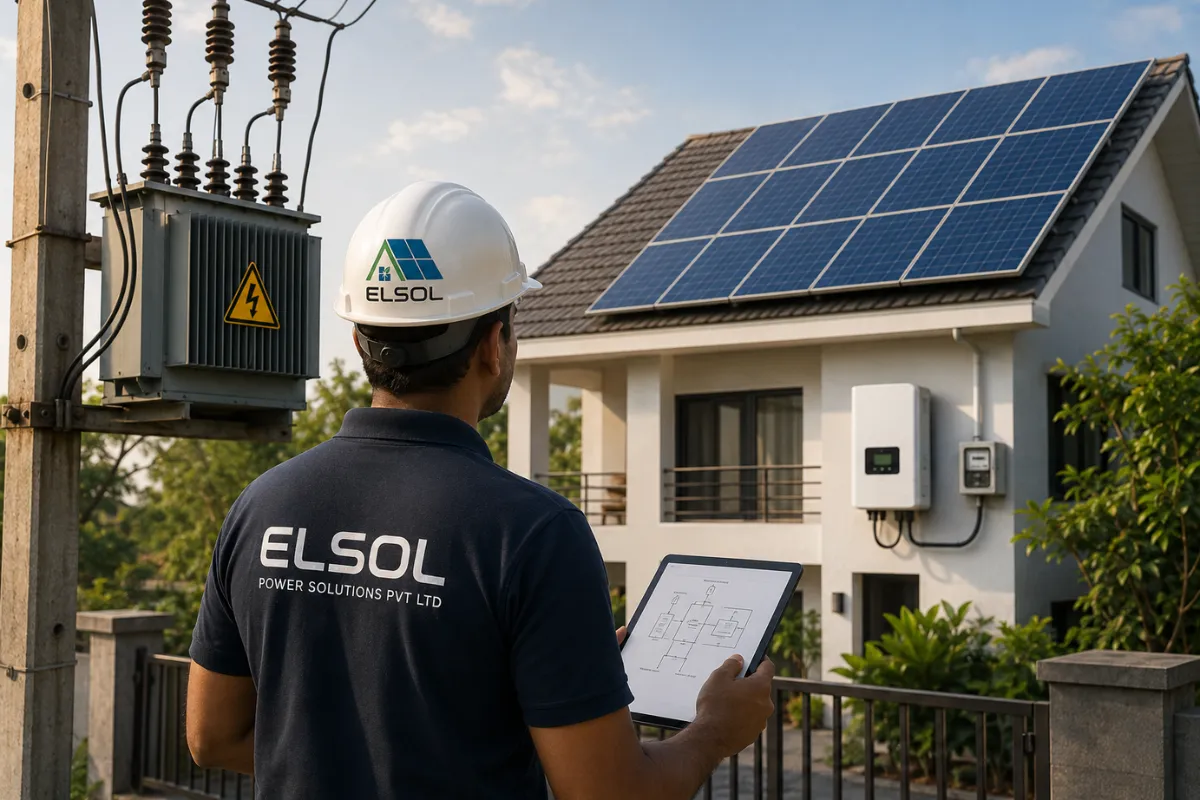


Transformer limits are the single biggest hidden constraint on rooftop solar installation today. Every distribution transformer in your neighbourhood can only accept a fixed amount of solar power back into the grid — in Kerala, a maximum of 90% of the transformer’s rated capacity — and once that ceiling is reached, KSEB stops approving new on-grid solar connections on that transformer. This capacity is allotted on a first-come, first-served basis, which means every month you delay, your neighbours are quietly using up the headroom that determines whether your solar panel for home gets approved at all.
In 2026, this is no longer a theoretical concern. In parts of Kochi and other high-adoption neighbourhoods, local transformers have already hit their permitted solar limit, and new on-grid connections are being paused or restricted. If rooftop solar is on your plan for this year, checking your transformer’s balance capacity — and acting while it still exists — should be your very first step.
What Is a Distribution Transformer, and Why Does It Limit Your Solar System?
Every home receives electricity through a distribution transformer (DTR), the familiar pole-mounted or ground-mounted unit that steps grid voltage down to the 230/240V your appliances use. Each transformer serves a cluster of homes and has a fixed capacity, measured in kilovolt-amperes (kVA).
Transformers were originally designed for one-way traffic: power flowing from the grid to your home. An on-grid (net-metered) rooftop solar system reverses that flow during the day. When your panels generate more than your home consumes, the surplus is exported back through the same transformer.
A little reverse flow is fine. But when dozens of homes on one transformer export at the same time on a sunny afternoon, the combined backfeed can push the transformer beyond safe limits. The consequences are real: overheating and premature transformer failure, voltage rising above safe levels on the local line, and grid-tied inverters tripping offline when voltage spikes — meaning your own system stops producing exactly when the sun is strongest.
To prevent this, regulators cap how much solar can connect to each transformer.
The 90% Rule: Kerala’s Official Limit
In Kerala, the cap is defined by Regulation 14(2) of the Kerala State Electricity Regulatory Commission (Renewable Energy and Net Metering) Regulations, 2020. The rule states that the cumulative capacity of distributed energy systems interconnected with the distribution network shall not exceed 90% of the distribution transformer’s capacity.
In plain terms: if your local transformer is rated 100 kVA, only about 90 kW of solar can ever be connected to it, shared among all your neighbours. Once feasibility approvals and grid-connected systems together reach that ceiling, KSEB stops approving new on-grid connections on that transformer until infrastructure is upgraded.
This is first-come, first-served. Your neighbour’s installation last month directly reduces the capacity available to you today.
The Situation in Kochi: A Warning for the Rest of Kerala
Kochi shows what happens when a city embraces solar faster than its grid can absorb it. The region generates roughly a fifth of Kerala’s total solar energy, and by late 2025 transformer loading in several areas had approached the 90% threshold, prompting KSEB to limit new domestic solar grid connectivity. Industry participants have reported that new installations in the region declined by around 20% in the months that followed.
KSEB is planning and implementing battery-energy-storage projects to support renewable-energy integration and grid management. However, grid-scale storage does not automatically remove capacity constraints at every local distribution transformer. Transformer upgrades take time, budget approvals, and planning — and homeowners in saturated pockets may wait a long while for capacity to reopen.
If your neighbourhood is seeing solar panels appear on roof after roof, treat that as a countdown clock, not just a trend.
How to Check Your Transformer’s Balance Capacity (Official KSEB Portal)
The good news: you do not need to guess. KSEB publishes transformer-wise data on its Web Self Service portal, exactly as required under Regulation 14(2).
Official link: https://wss.kseb.in/selfservices/reCap
Here is how to use it:
- Open the portal and select the district where your KSEB section office is located.
- Select your electrical section (this is printed on your electricity bill).
- The portal displays every transformer in that section with four key figures: 90% of DTR capacity (kW), Feasibility Issued (kW), Grid Connected (kW), and Balance Available (kW).
The number that matters to you is Balance Available. If your transformer shows, say, 12 kW balance, a 5 kW home system is comfortably feasible today. If it shows 0 kW or a figure smaller than the system you want, a standard net-metering connection will not be approved on that transformer right now.
One important nuance: “Feasibility Issued” counts approvals already granted to others who have not yet installed. Capacity you see today can be claimed by someone else tomorrow. If the portal shows balance available for your transformer, that is your green signal to move immediately — not a reason to relax.
Other Limits That Cap Your System Size
Transformer capacity is the neighbourhood-level constraint, but two personal constraints also apply:
Your sanctioned/connected load. Under Kerala’s net-metering framework, your solar plant capacity is generally tied to the sanctioned load of your electricity connection. A home with a 5 kW connection cannot typically install a 10 kW net-metered plant without first enhancing the connection. Check the sanctioned load printed on your bill before sizing your solar panel for home.
Technical feasibility of your premises. Before approval, KSEB conducts a feasibility check covering your service line, meter, phase (single vs three-phase), and local network conditions. Experienced solar panel installers registered/empanelled with the utility should complete this feasibility process before you pay for equipment — never after.
What If Your Transformer Is Already Full?
A saturated transformer does not mean solar is off the table. It means the standard export-to-grid model is off the table for now. Your realistic options:
1. Zero-export (non-export) system. Your solar powers your home during the day, but an export-limiting device blocks any surplus from reaching the grid. You still cut daytime consumption, but you lose the value of exported units — reducing savings, especially for homes empty during working hours.
2. Hybrid system with battery storage. Instead of exporting surplus, you store it in a battery and use it in the evening. Upfront cost is higher, but you keep almost all the value of your generation, gain backup during outages, and are not dependent on transformer headroom. As battery prices continue to fall, this has become the most popular workaround in saturated areas.
3. Wait for a transformer upgrade. KSEB augments transformers over time, and BESS deployments may relieve some pressure. But there is no guaranteed timeline, and freshly added capacity is consumed quickly in high-demand areas.
4. Request connection enhancement. In some cases, discussing load enhancement or alternate arrangements with your section office can open a path, though this depends entirely on local network conditions.
Notice something about all four options: every one of them is either slower, costlier, or less rewarding than simply installing while transformer capacity is still available. The cheapest, highest-savings version of rooftop solar is the one you install before your transformer fills up.
Why Installing Early Is the Smartest Financial Move
Transformer capacity is a shared, shrinking resource, and delay carries three compounding costs:
- Bills you keep paying. Every month without solar is another month of full-tariff electricity bills — money that never comes back.
- Capacity claimed by neighbours. The balance available on your transformer today can be locked up by someone else’s feasibility approval tomorrow.
- A forced downgrade later. If you miss the window, you may be pushed into a smaller system or a zero-export configuration. Over a 25-year system life, being forced from a 5 kW export-enabled plant down to a 3 kW zero-export plant can mean several lakh rupees in lost savings.
The homeowners winning in 2026 are not the ones who waited for prices to drop another few percent. They are the ones who verified capacity, booked their feasibility, and installed while headroom existed. Once your net-metering connection is approved and commissioned, your share of the transformer is secured for the life of your system.
Your 5-Step Action Plan (Do This This Week)
- Check Balance Available for your transformer at wss.kseb.in/selfservices/reCap — it takes two minutes.
- Confirm your sanctioned load on your electricity bill.
- Contact registered solar panel installers and request a formal feasibility study — this is what locks in your slot on the transformer.
- If capacity is tight, get quotes for hybrid/battery options alongside standard on-grid.
- Re-check the portal just before signing, and submit your application without delay — balance capacity changes continuously.
Conclusion: The Window Is Open — But It Is Closing
Rooftop solar remains one of the best investments a homeowner can make, but in 2026 the deciding factor is no longer panel price — it is transformer capacity. The 90% rule is fixed, the data is public, and the queue moves fast. Check your transformer today; if capacity exists, act on it this week, because feasibility approval is what reserves your place.
If you want the process handled end-to-end — capacity check, feasibility application, system design, subsidy paperwork, and commissioning — partner with an experienced solar company in Kerala that knows the KSEB approval process inside out. El Sol Power Solutions Pvt Ltd helps homeowners verify their transformer’s balance capacity, secure feasibility approval quickly, and install the right on-grid or hybrid system before the local window closes. The sun is not running out — but your transformer’s capacity might be. Start today.
Frequently Asked Questions
1. What is the transformer limit for solar in Kerala?
The cumulative capacity of all renewable energy systems connected to a distribution transformer cannot exceed 90% of that transformer’s rated capacity, as per Regulation 14(2) of the KSERC (Renewable Energy and Net Metering) Regulations, 2020.
2. How do I check if my area’s transformer capacity is full?
Use KSEB’s official Web Self Service portal at https://wss.kseb.in/selfservices/reCap. Select your district and section to see each transformer’s 90% capacity, feasibility issued, grid-connected capacity, and balance available in kW.
3. Can I still install solar if the transformer capacity is exhausted?
Yes, but not as a standard net-metered export system. You can install a zero-export system or a hybrid system with battery storage, or wait for KSEB to upgrade the transformer. All of these routes are slower or less rewarding than installing while capacity is available.
4. Why did KSEB restrict new solar connections in Kochi?
Several transformers in Kochi neighbourhoods approached the 90% loading threshold because large volumes of daytime surplus solar were flowing back into the grid, risking transformer failure. KSEB paused new domestic on-grid approvals in those pockets and is deploying battery storage systems statewide to help absorb surplus generation.
5. Does transformer capacity affect off-grid solar?
No. A fully off-grid system does not interact with the distribution network, so the 90% rule does not apply. It applies to on-grid (net-metered) and any grid-interactive configuration that exports power.
6. How fast should I act if my transformer shows balance capacity?
Immediately. Balance capacity is reduced every time KSEB issues a feasibility approval to anyone on your transformer — not just when systems are installed. Submitting your feasibility application is what reserves your share.


