
Solar Inverter Guide: How to Choose the Right One for Your Home
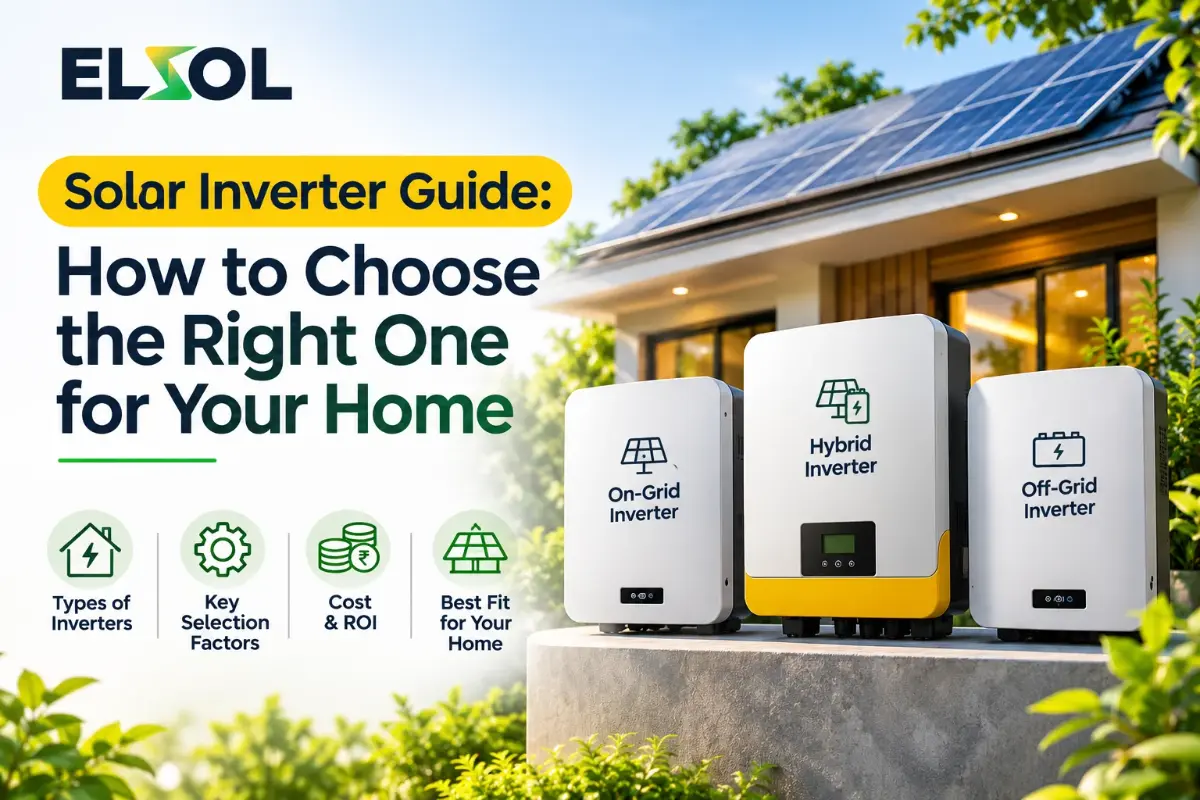


The solar panels on your roof get all the attention, but the inverter is the device that decides how much of that generation you actually use. It turns direct current from your panels into usable alternating current, talks to your utility grid, manages your battery if you have one, and shuts itself down safely when the grid fails. Pick the wrong inverter and a perfectly good solar array underperforms for 25 years.
In 2026 the inverter market has grown more complex, not less. String inverters, microinverters, hybrid inverters, and grid-tied units each solve a different problem. Pricing bands overlap. Warranty terms vary from five years to twenty-five. And Indian buyers now have to factor in battery readiness, EV charging compatibility, and the shift toward time-of-day tariffs.
This guide walks you through everything a homeowner needs to know to buy the right solar inverter in India today.
Quick Answer
- Grid-tied (on-grid) inverter: Cheapest, best for homes with reliable grid supply and no battery plans.
- Hybrid inverter: Best overall choice for most Indian homes in 2026. Works like a grid-tied unit today and accepts a battery whenever you add one.
- Off-grid inverter: Suitable for remote locations without grid access or homes that require an independent power supply.
- Microinverters: The premium choice for shaded or complex roofs, or homes where each panel’s output matters.
What Does a Solar Inverter Actually Do?
A solar inverter performs four jobs simultaneously:
- DC to AC conversion: Converts the direct current generated by your photovoltaic (PV) panels into 230V 50Hz alternating current that matches the Indian utility grid standard.
- Maximum Power Point Tracking (MPPT): Continuously adjusts the electrical operating point of the panels to extract the highest possible power as sunlight and temperature change through the day.
- Grid synchronisation: Synchronises its AC output with the utility grid’s voltage, frequency, and phase so that solar-generated electricity can be safely supplied to the grid.
- Safety and protection: Detects faults, disconnects during a grid outage (anti-islanding), and protects against overvoltage, overcurrent, and short circuits.
Modern units also handle remote monitoring, firmware updates, and communication with batteries or EV chargers.
The Four Main Inverter Types
1. String Inverters (Grid-Tied)
The most common residential inverter in India. Panels are wired together in series into one or two long strings, and the entire string feeds a single central inverter unit, usually wall-mounted near the main electrical panel.
Strengths:
- Lowest upfront cost per kW
- Simple wiring, quick installation
- Easy to access for maintenance
- Mature technology with wide service network in India
Weaknesses:
- A single underperforming panel (shaded, dirty, or damaged) pulls down the entire string
- Replacement is likely once during the 25-year panel life, since typical string inverter life is 10 to 15 years
- No battery backup during outages
- Single point of failure for the whole array
2. Microinverters
Microinverters are installed close to the solar panels and convert DC electricity into AC electricity at the panel level or across a small group of panels, depending on the model’ converting DC to AC right at the source. The home sees AC power from every panel instead of a combined DC string.
Strengths:
- Each panel operates independently, so shading or soiling on one unit does not drag down the rest
- Longer warranty, often 20 to 25 years (matches the panel warranty)
- Panel-level monitoring, which makes fault detection far easier
- Lower DC voltage on the roof, which improves fire safety
- Easier to add panels later, one at a time
Weaknesses:
- 25% to 40% higher upfront cost
- Multiple units on the roof means replacements involve climbing up
- Still relatively niche in India, with a thinner installer network outside metros
3. Hybrid Inverters
A single device that manages solar generation, battery storage, and grid interaction. In 2026 this has become the default smart choice for Indian homes planning for the next decade.
Strengths:
- Runs as a grid-tied unit today without a battery
- Allows battery integration at a later stage, provided the selected battery is compatible with the inverter’s specifications and communication requirements.
- Provides backup power to essential loads during outages
- Supports time-of-day optimisation
- Works with EV chargers for solar-charged overnight charging
Weaknesses:
- 20% to 50% costlier than a basic grid-tied inverter
- Slightly more complex installation
- Choose a battery-compatible brand or risk vendor lock-in
4. Off-Grid Inverters
Operate independently of the utility grid. Requires a battery bank sized for the home’s full consumption.
Strengths:
- Full energy independence
- Right fit for remote homes, farmhouses, villages with weak grid
Weaknesses:
- Highest total system cost because batteries are mandatory
- Not eligible for PM Surya Ghar subsidy, which requires grid connection
- Batteries need replacement every 7 to 10 years
Side-by-Side Comparison
| Feature | Grid-Tied (String) | Microinverter | Hybrid | Off-Grid |
| Battery support | No | Yes (with separate storage inverter) | Yes, built-in | Yes, required |
| Backup during outage | No | No (without battery) | Yes | Yes |
| Shading tolerance | Low | Excellent | Moderate | Moderate |
| Panel-level monitoring | No | Yes | Partial | Partial |
| Typical lifespan | 10 to 15 years | 20 to 25 years | 10 to 15 years | 10 to 15 years |
| Warranty | 5 to 10 years | 20 to 25 years | 5 to 10 years | 5 to 10 years |
| Cost (5 kW system, inverter only) | ₹35,000 to ₹55,000 | ₹70,000 to ₹1,10,000 | ₹65,000 to ₹1,20,000 | ₹55,000 to ₹95,000 |
| PM Surya Ghar subsidy | Yes | Yes | Yes | No |
| Expansion flexibility | Low | Excellent | High | Moderate |
| Best fit | Simple sunlit roof, tight budget | Complex or shaded roof, long term | Future-ready homes, battery or EV plans | Off-grid locations |
Prices are indicative for Indian retail as of November 2026 and vary by brand, single vs three phase, and feature set.
How to Size Your Solar Inverter
Inverter sizing rules have changed in 2026. The old advice of “match inverter kW to panel kW” is being replaced by intentional DC oversizing, where the panel array is rated 10% to 25% higher than the inverter’s AC output.
Why? Panels rarely hit their rated output in real-world Indian conditions due to heat, dust, and angle losses. A slightly oversized array lets the inverter run closer to its optimal efficiency for more hours of the day, lifting total generation.
Sizing checklist:
- Calculate your daily consumption: Check the past 12 months of electricity bills. Divide the annual units by 365 to get your daily average in kWh.
- Convert consumption to required solar capacity: In most of India, 1 kW of solar generates roughly 4 to 4.5 units per day. So 20 units/day divided by 4 gives you a 5 kW panel array.
- Pick inverter AC capacity: 20% below the panel DC capacity is a good target. For a 5 kW panel array, a 4 to 4.2 kW inverter is often ideal.
- Verify sanctioned load: The permissible rooftop solar capacity depends on the consumer’s sanctioned load and the applicable state/DISCOM regulations. Confirm the approved capacity with the local DISCOM before finalising the system size.
- Account for motor surges: Refrigerators, pumps, and air conditioners draw 3 to 5 times their rated wattage at startup. Confirm the inverter’s surge capacity is sufficient.
- Plan for future load growth: If you plan to add an EV charger, an inverter AC, or a second refrigerator in the next five years, size up by 20%.
7 Features That Separate Good Inverters from Great Ones
1. Dual or Multi-MPPT Channels
MPPT channels let different sections of your panel array operate at different optimal points. If your roof has panels facing east and west, or some panels partially shaded, two MPPT channels can increase total output by 8% to 15%. One MPPT is fine for a single flat array; two is better for anything more complex.
2. Conversion Efficiency
Look for inverters with peak efficiency above 97% and European or CEC-weighted efficiency above 96%. A 2% efficiency gap sounds small but compounds to roughly 1,000 extra units per year on a 5 kW system.
3. IP Rating
IP65 is the minimum for outdoor mounting. IP66 or IP67 is better for dusty, humid, or coastal locations. An under-rated inverter installed outside in Chennai or Mumbai will fail inside five years.
4. Smart Monitoring
Wi-Fi or 4G monitoring with a mobile app is standard in 2026. Confirm the app shows real-time generation, historical graphs, fault alerts, and ideally panel-level or string-level breakdowns. Check whether the brand charges extra for monitoring beyond the first year.
5. Battery Compatibility
Hybrid inverters should support 48V LFP or lithium-ion battery packs from multiple approved brands. Avoid units that lock you into a single battery vendor, and confirm the inverter speaks CAN bus or RS485 protocols to the battery.
6. Grid Code Compliance
MNRE and BIS compliance is non-negotiable in India. For PM Surya Ghar installations, verify that the solar modules meet the applicable ALMM and Domestic Content Requirement conditions. Separately, ensure that the inverter complies with the applicable BIS and MNRE technical and safety requirements.
7. After-Sales Service Network
A 10-year warranty is worthless if the nearest service centre is 400 km away. Check that the brand has a service presence in your city and ask the installer what the typical fault resolution time is.
Red Flags to Watch Out For
- Warranty less than five years on any premium inverter
- Vague efficiency claims without CEC or European weighting
- “Universal” battery compatibility without a specific supported-list
- No ALMM listing for the exact model (not just the brand)
- Pushy upsell toward oversized inverters you do not need
- Service network limited to one state or city
- Firmware that cannot be updated remotely
Common Scenarios and Recommendations
Scenario 1: 2 BHK apartment, moderate grid reliability, budget focused. A 3 to 4 kW grid-tied string inverter from a reputable Indian brand hits the sweet spot. Payback in 3.5 to 4.5 years after PM Surya Ghar subsidy.
Scenario 2: Independent house, frequent outages, plans to add a battery in two years. A 5 kW hybrid inverter installed today, battery added later. The small premium over a grid-tied unit buys you a battery-ready platform without a second installation.
Scenario 3: Multi-storey bungalow with an east-west roof and partial shading from a neighbour’s building. Microinverters on every panel. The efficiency gain on complex roofs usually pays back the cost premium in six to eight years.
Scenario 4: Farmhouse on weak grid or no grid at all. Off-grid inverter paired with a correctly sized lithium battery bank. Budget roughly double a grid-tied setup.
Scenario 5: Homeowner planning to buy an EV within three years. Hybrid inverter with proven EV charger compatibility. Charging an EV from stored solar at night turns a ₹10 per unit grid tariff into near-zero running cost.
Related Concepts Worth Knowing
- Photovoltaic (PV): The umbrella term for solar-electricity technology.
- Net metering: A bidirectional billing arrangement where exported solar is netted off against imported electricity.
- Anti-islanding: The safety feature that forces a grid-tied inverter to shut down during a grid outage.
- Rapid shutdown: A circuit-level safety feature that de-energises the DC side of the system within seconds, important for firefighter safety.
- Time-of-day (ToD) tariff: DISCOM pricing structure where electricity costs more during peak evening hours. Growing in Maharashtra, Karnataka, and Delhi.
- CEC efficiency: A weighted efficiency rating used by the California Energy Commission that reflects real-world performance better than peak efficiency.
- BoS (Balance of System): All the non-panel, non-inverter hardware: cables, mounting structure, junction boxes, meters, and isolators.
- PCU (Power Conditioning Unit): Indian industry term often used interchangeably with hybrid inverter.
Frequently Asked Questions
Q1. What size inverter do I need for a 5 kW solar system?
Aim for a 4 to 4.2 kW AC inverter paired with a 5 kW panel array. This 20% DC oversizing usually improves annual generation by 5% to 8% in typical Indian conditions.
Q2. Can I use an on-grid inverter without net metering?
Technically yes, but you lose most of the financial benefit. Without net metering, any surplus solar is simply wasted. Apply for net metering before commissioning the system.
Q3. How long do solar inverters typically last?
String and hybrid inverters: 10 to 15 years. Microinverters: 20 to 25 years. Batteries, if used, have their own 7 to 10 year warranty cycle.
Q4. Are three-phase inverters better than single-phase?
Only if your home has a three-phase electrical connection. The choice between single-phase and three
phase inverters depends on the property’s electrical connection, system capacity and applicable DISCOM regulations. Confirm the required connection type before installation. Below 5 kW, single-phase is simpler and cheaper.
Q5. Can I mix brands between my solar panels and inverter?
Yes. Solar panels and inverters can be used together when their electrical specifications are compatible, including operating voltage, maximum input voltage, current limits, MPPT range and string configuration. Most installers mix brands based on best value.
Q6. Does an inverter need regular maintenance?
Minimal. Annual visual inspection, dust cleaning of air vents, and firmware updates. Solar inverters generally require limited routine maintenance, but periodic inspection, ventilation cleaning and firmware updates should be carried out according to the manufacturer’s recommendations
Q7. What happens to my inverter during a power cut?
A grid-tied inverter shuts down for safety. A hybrid or off-grid inverter with a battery continues to run essential loads. This is the main reason hybrid inverters are gaining share in 2026.
Q8. Is a Wi-Fi monitoring feature actually useful?
Yes. It catches faults quickly, shows you whether a dirty panel is costing you generation, and gives you data to confirm the installer’s output promises.
Conclusion
The right solar inverter for your home depends on three questions: how reliable is your grid, are you planning to add a battery or EV in the next five years, and does your roof have shading or complexity? Answer those and the inverter type almost picks itself.
For a simple sunlit rooftop with a reliable grid and no battery plans, a quality grid-tied string inverter from an ALMM-listed brand is still the most cost-effective option. For most other Indian homes in 2026, a hybrid inverter is the smarter long-term purchase because it is battery-ready without committing you to the battery today. Microinverters shine on complex roofs and premium installations where panel-level monitoring and maximum lifetime output matter more than lowest upfront cost.
Consulting an experienced solar installation company that offers multiple inverter options can help you compare different technologies and select a solution based on your requirements” Established installers such as El Sol Power Solutions can audit your load profile, roof geometry, grid reliability, and future expansion plans before suggesting a specific capacity and inverter type, so the final choice reflects
your home and not a stock-clearing push from the installer.
Pick the inverter for the system you will still be running in 2040, not just the box that costs least today. The inverter is the brain of your solar setup, and that is one piece of hardware worth getting right the first time.


