

Solar Panel Direction: Best Angle for Maximum Output
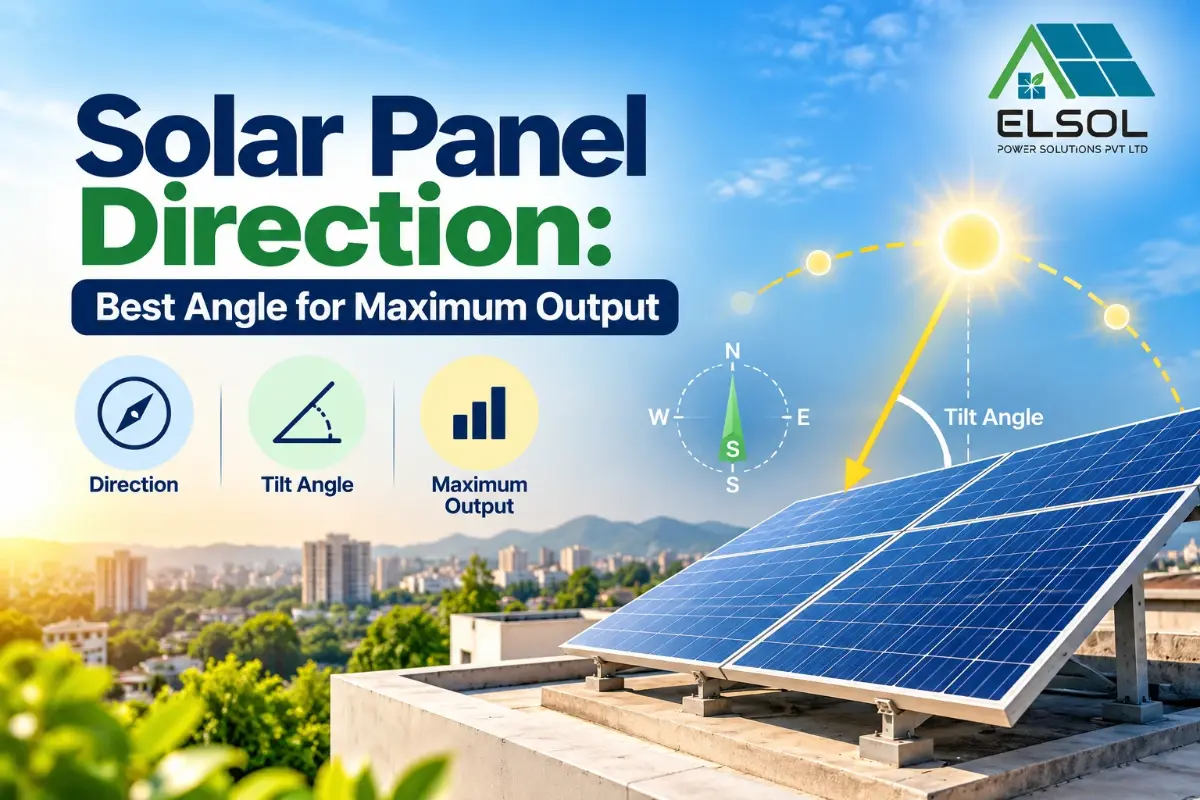


Choosing the right direction and tilt angle for your solar panels is one of the most important decisions in any rooftop solar project. Panels facing the wrong direction, or set at the wrong tilt, can lose 10% to 25% of their annual output. That is a significant hit to your savings and your payback period, and it is entirely preventable with the right planning.
In this guide, we will break down the best solar panel direction for Indian homes in 2026, the ideal tilt angle for different parts of the country, and how to handle rooftops that do not face the perfect direction. Everything here is written for Indian conditions, with practical answers for homeowners planning a new rooftop solar installation.
Why Solar Panel Direction Matters
A solar panel produces the most electricity when sunlight hits its surface directly, at a 90 degree angle. The closer your panels are aligned to this ideal angle across the full day, the more power they generate. Direction (also called azimuth) and tilt (the vertical angle) together decide how much usable sunlight your rooftop solar system captures each year.
Get both right, and a well sized 5kW system in India typically generates 20 to 22 units per day in good months. Get either one wrong, and the same system might struggle to touch 16 to 18 units. Over 25 years, that difference adds up to lakhs of rupees in lost generation.
Best Direction for Solar Panels in India
India sits in the Northern Hemisphere, which means the sun travels across the southern half of the sky for most of the year. For almost every rooftop in the country, true south is the ideal direction for solar panels. South facing panels catch the strongest sunlight for the longest stretch of the day, from mid morning to mid afternoon.
A quick note worth knowing: when we say south, we mean true (geographic) south, not the magnetic south your phone compass points to. The two can differ by a few degrees depending on where you live. For a precise installation, a qualified installer uses a solar pathfinder or a shading analysis tool to lock in the correct orientation.
If your rooftop faces true south with no obstructions, you are starting from the best possible position. For every other roof direction, there are practical workarounds, and most of them still deliver excellent returns.
East Facing vs West Facing Solar Panels
Not every Indian rooftop faces south. If yours faces east or west, you can still install a strong system. The difference lies in when your panels produce the most power.
East facing panels generate the most electricity in the morning, from sunrise until about noon. These suit households that run high loads in the morning, like water heaters, washing machines, or morning cooking appliances.
West facing panels generate the most electricity in the afternoon and early evening, from noon until sunset. These are an excellent match for homes that use heavy loads in the afternoon and evening, like air conditioners, which usually run hardest between 2 PM and 7 PM.
Compared to a south facing array of the same size, east or west facing panels in India generate roughly 10% to 15% less electricity on an annual basis. The gap closes further when the system is combined with net metering, because every unit exported during the day earns a credit regardless of when it was generated.
Some installers also recommend an east west split array, where half the panels face east and half face west. This spreads production across the full day and often works better for homes without a true south facing roof section.
What About North Facing Rooftops?
North facing panels receive the least direct sunlight in India, which is why many installers recommend avoiding this orientation when possible. A north facing panel typically produces 20% to 25% less annual electricity than a south facing one of the same size.
That said, a north facing roof is not a dead end. If south, east, or west options are not available, you still have two practical paths:
- Use a tilted mounting structure that angles the panels toward the south, independent of the roof slope. This is common on flat terraces and even on gently sloped roofs.
- Install on a different roof section if your building has multiple roof planes.
A skilled installer will survey all of these options during a site visit and recommend the layout that captures the most sunlight for your specific rooftop.
Ideal Tilt Angle for Solar Panels in India
Tilt angle matters as much as direction. The right tilt makes sure your panels sit at the best angle relative to the sun’s path through the year.
A simple and widely used rule for India is to set the tilt angle equal to the latitude of your location. The further north you live, the steeper the tilt. Here is a quick reference for major Indian cities in 2026:
| City | Latitude | Recommended Tilt |
| Thiruvananthapuram | 8.5° N | 8° to 12° |
| Chennai | 13° N | 12° to 15° |
| Bengaluru | 13° N | 12° to 15° |
| Mumbai | 19° N | 18° to 22° |
| Hyderabad | 17.4° N | 17° to 20° |
| Ahmedabad | 23° N | 22° to 25° |
| Delhi | 28.6° N | 28° to 30° |
| Jaipur | 26.9° N | 26° to 30° |
A few points worth keeping in mind:
- A fixed tilt is set once and never changed. For most Indian rooftop solar systems, this is the standard setup.
- For a small annual yield gain of 3% to 8%, some installers offer seasonal tilt adjustment, where you (or a technician) manually change the tilt two or three times a year.
- In very hot regions, a slightly steeper tilt helps rain wash dust and grime off the panels more effectively, which reduces cleaning costs.
For Kerala and most of South India, a 10 to 15 degree tilt works well. For North India, you need a steeper tilt to catch the lower winter sun.
Direction and Tilt Together: What Really Changes Your Output
Direction and tilt interact. A panel that faces slightly off from south can still perform well if the tilt compensates. For example, a roof oriented 10 degrees west of true south often performs almost identically to a true south roof if the tilt is adjusted slightly.
This flexibility is why experienced installers rarely panic over a non ideal roof direction. The combination of direction and tilt, along with careful shade analysis, usually recovers most of the production you might otherwise lose.
Three other factors shape the final generation number, and all of them matter more than small direction errors:
- Shading from trees, water tanks, satellite dishes, and nearby buildings, which can cut output by 30% or more if ignored.
- The quality of the panels and inverter, where TOPCon modules and MPPT inverters outperform older setups.
- Installation quality, including correct wiring, torque settings, and clean junction connections.
A trusted solar company in India will walk you through all three during the site survey, not just the direction and tilt.
Common Rooftop Scenarios and What Works Best
Every Indian rooftop is a little different. Here are the common ones and how to handle them:
- Flat terrace (RCC roof): The best case for direction flexibility. The installer uses a tilted mounting structure to point panels true south at the ideal angle, regardless of the building’s orientation.
- Pitched tile roof facing south: Install directly on the roof with the panels following the slope. This is simple, cost effective, and typical for Kerala homes.
- Pitched roof facing east or west: Install along the natural slope. Expect 10% to 15% less annual output than a true south install.
- Pitched roof facing north: Use a modified mounting structure to tilt the panels back toward the south, or move to a different roof section.
- Partial shading from a tall building nearby: Consider micro inverters or power optimizers, which reduce the production loss when some panels are shaded.
Mistakes to Avoid With Panel Direction
A few mistakes come up often in the field, and each one quietly reduces your long term returns:
- Ignoring shade analysis and installing panels where a tree, water tank, or neighbor’s wall casts shadow for part of the day.
- Trusting a phone compass instead of a proper site survey to determine true south.
- Oversizing the system to compensate for a bad direction, when the fix is actually to correct the mounting angle or move panels to a different roof section.
- Skipping monitoring, which means you only find out about underperformance months later when the bill tells you.
A reputable installer handles all of these during the design stage, so these problems never show up in your monthly bills.
Why El Sol Power Solutions Pays Close Attention to Direction and Tilt
At El Sol Power Solutions, we treat direction and tilt as design decisions, not afterthoughts. Every solar panel installation starts with a full site survey that covers roof orientation, available shadow free area, structural load capacity, and the exact tilt that fits your latitude and your roof’s geometry.
Our team uses tools that give us the real solar path for your location, not a generic rule of thumb. For Kerala rooftops in particular, we design around monsoon shading, salt air exposure, and the specific tilt angles that help panels stay cleaner through heavy rains. The result is a rooftop solar system that produces close to its design output year after year, not one that quietly underperforms.
If you are planning a new installation and are not sure how your roof’s direction affects your options, a site visit from our team gives you concrete numbers for your specific property.
Frequently Asked Questions
1. What is the best direction for solar panels in India?
True south is the best direction for most Indian rooftops. South facing panels receive the most direct sunlight through the day and generate the highest annual output.
2. Can I install solar panels on an east or west facing roof?
Yes. East and west facing panels work well in India, with roughly 10% to 15% less annual production than a true south array of the same size. The difference is often fully offset by net metering credits.
3. What is the ideal tilt angle for solar panels in India?
A tilt angle equal to your location’s latitude is a strong starting point. For South India, 10 to 15 degrees works well. For North India, 25 to 30 degrees is more typical.
4. Should I avoid north facing roofs entirely?
Not necessarily. A north facing roof can still work with a tilted mounting structure that angles the panels south, or by moving to a different roof section if available.
5. Does roof direction affect my PM Surya Ghar subsidy?
No. The subsidy is tied to system capacity (up to Rs. 78,000 for 3 kW and above), not to direction or tilt. However, a well oriented system generates more electricity, which improves your actual savings.
6. How accurate does the direction need to be?
Being within 10 to 15 degrees of true south is good enough for most installations. Beyond that, the installer may compensate with tilt adjustments or recommend a different roof section.
Conclusion
Solar panel direction and tilt angle are the two settings that quietly decide how much electricity your rooftop produces for the next 25 years. In India, true south at a tilt equal to your latitude is the ideal starting point, but good installers can design around almost any rooftop with the right combination of orientation, tilt, and mounting structure.
If you are planning a solar panel installation and want a design built around your actual rooftop (not a generic template), the El Sol Power Solutions team is one phone call away. We handle the site survey, DISCOM approvals, PM Surya Ghar subsidy filing, and the long term monitoring that keeps your system producing what it was designed to produce.
A rooftop solar system is a 25 year investment. Getting the direction and tilt right at the start is the simplest way to make sure every one of those years pays you back.


