
Solar + EV Charging at Home: Cost, Setup & How Much Solar You Need
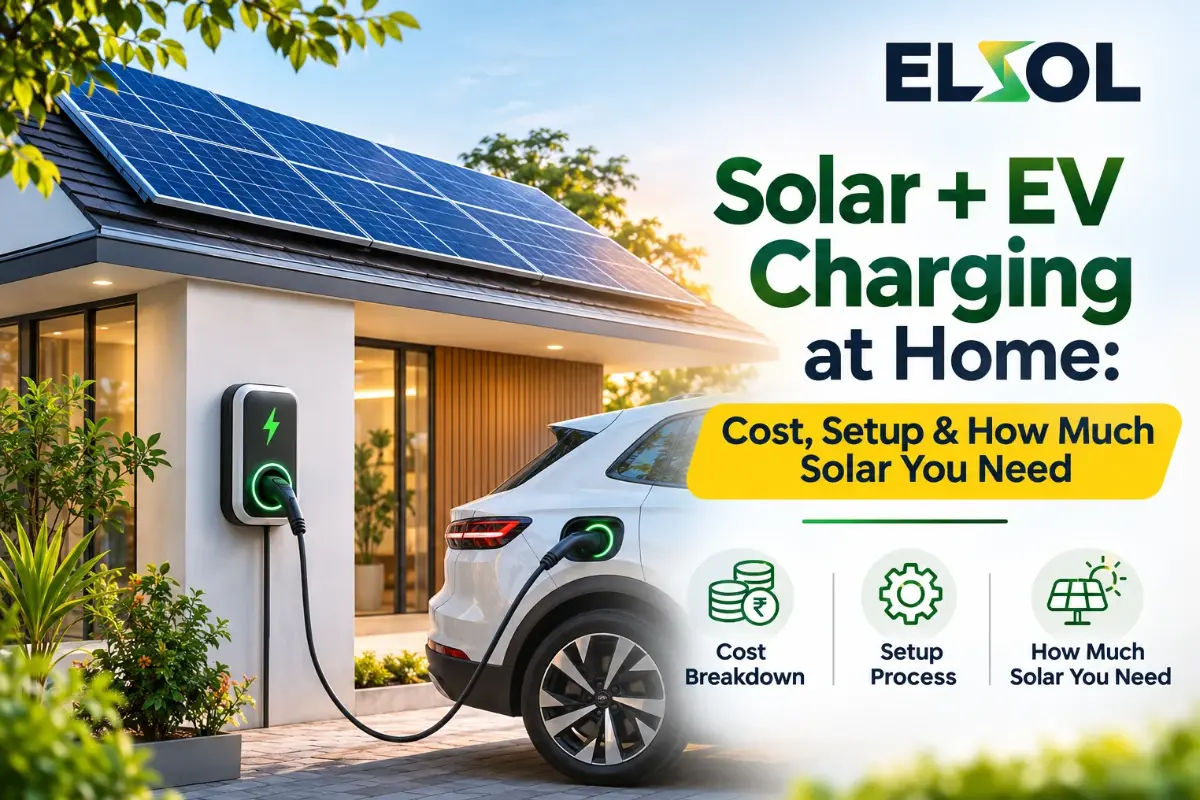


An electric car and a rooftop solar system are two of the best financial decisions an Indian homeowner can make in 2026. Together, they unlock something neither can achieve alone: near-zero running cost per kilometre.
A petrol car costs roughly ₹8 to ₹11 per kilometre to run at today’s fuel prices. The same car charged from the grid costs about ₹1.50 to ₹2 per kilometre at residential tariffs. Charge it from your own rooftop solar and that number drops to roughly ₹0.50 to ₹0.80 per kilometre, counting only the amortised cost of the panels.
Across a typical 10-year ownership of an EV driven 15,000 km per year, that difference compounds to savings of ₹10 lakh to ₹14 lakh, before factoring in fuel inflation.
The question most Indian buyers now face is not whether to combine solar and EV charging at home, but exactly how much solar to install, which EV charger fits the setup, whether to add a battery, and what the total project costs after subsidy.
This guide walks you through the math and the decisions.
Quick Answer
- Light EV user (500 km/month): 3 kW rooftop solar system with a 3.3 kW AC charger. The estimated total project cost is approximately ₹2 lakh to ₹2.6 lakh after the applicable ₹78,000 subsidy.
- Average EV user (1,200 km/month): 5 kW rooftop solar system with a 7.4 kW AC charger. The estimated total project cost is approximately ₹3.5 lakh to ₹4.8 lakh after the applicable subsidy.
- Heavy EV user (2,500 km/month) or multi-car household: 8 kW rooftop solar system with a 7.4 kW AC charger. The estimated total project cost is approximately ₹6 lakh to ₹8.5 lakh after the applicable subsidy.
- DC fast chargers are generally impractical for most homes because of their higher equipment cost, power demand and installation requirements. Follow the vehicle manufacturer’s charging recommendations.
How EV Charging and Solar Actually Fit Together
An electric car is basically a very large battery on wheels. A typical mid-range EV in India has a 40 to 60 kWh battery pack. That battery needs to be filled on your schedule, which usually means overnight, but your solar panels generate only during daylight hours.
Three architectures solve this mismatch:
1. Grid-tied solar with net metering (most common). Your panels export surplus daytime generation to the grid and earn credits. You charge the EV at night from grid electricity, and the credits offset the import on your monthly bill. Simplest and cheapest setup.
2. Hybrid solar with battery storage. A hybrid solar system with battery storage can reduce dependence on grid electricity. The level of energy independence depends on solar generation, usable
battery capacity, household demand and backup configuration.
3. Daytime direct charging. Park the EV at home during peak solar hours (9 AM to 4 PM) and charge directly from the panels. Best for work-from-home owners, two-car households where one car stays home, or weekend-heavy driving patterns.
Most Indian buyers in 2026 start with architecture 1 (grid-tied with net metering) and upgrade to architecture 2 (hybrid with battery) only if the grid is unreliable or time-of-day tariffs make night charging expensive.
How Much Solar Capacity Do You Actually Need?
Step one is understanding your real EV electricity consumption, then layering it on top of your existing household load.
The baseline numbers:
- 1 kW of rooftop solar in India generates roughly 4 to 4.5 units (kWh) per day, or about 120 to 135 units per month
- A typical EV consumes roughly 6 to 8 km per unit of electricity (your real-world mileage depends on model, driving style, and AC usage)
- A typical Indian household (without EV) consumes about 250 to 400 units per month
Sizing by monthly kilometres:
| Monthly EV Km | EV Units Needed | Household Baseline | Total Monthly Units | Recommended Solar | Roof Area |
| 300 km | 45 units | 300 units | 345 units | 3 kW | 250 to 300 sq ft |
| 500 km | 70 units | 300 units | 370 units | 3 to 4 kW | 300 to 350 sq ft |
| 1,000 km | 140 units | 350 units | 490 units | 5 kW | 400 to 500 sq ft |
| 1,500 km | 215 units | 400 units | 615 units | 5 to 6 kW | 450 to 550 sq ft |
| 2,000 km | 285 units | 450 units | 735 units | 7 kW | 550 to 650 sq ft |
| 2,500 km | 360 units | 500 units | 860 units | 8 kW | 650 to 750 sq ft |
| 3,500 km | 500 units | 550 units | 1,050 units | 10 kW | 800 to 900 sq ft |
A quick sizing formula:
Required solar capacity (kW) = combined monthly consumption (kWh) ÷ the
estimated monthly generation per kW for the site.
Choosing the Right Home EV Charger
Three charger ratings matter for Indian homes.
3.3 kW AC charger (single-phase):
- Charging speed: approximately 15 to 20 km of range per hour
- Full charge time (40 kWh EV): 12 to 14 hours
- Price: ₹15,000 to ₹25,000
- Best fit: Light EV users (under 500 km/month), hatchbacks, single-phase home connections
7.4 kW AC charger (single-phase):
- Charging speed: approximately 35 to 45 km of range per hour
- Full charge time (40 kWh EV): 5 to 6 hours
- Price: ₹35,000 to ₹55,000
- Best fit: Average to heavy drivers, most mid-range EVs, overnight charging with margin
11 kW AC charger (three-phase):
- Charging speed: approximately 55 to 70 km of range per hour
- Full charge time (60 kWh EV): 5 to 6 hours
- Price: ₹55,000 to ₹90,000
- Best fit: Large EVs, two-car households, three-phase electrical connections, high daily mileage
Features worth paying for:
- Smart scheduling (set charging to begin at specific times)
- Load management (prevents tripping the home connection when heavy appliances run)
- RFID authentication (prevents unauthorised use)
- Wi-Fi monitoring (track consumption and cost per session)
- Solar-aware charging (matches charging rate to real-time solar generation)
Features to skip:
- DC fast charging at home (hardware costs ₹2 to ₹5 lakh and stresses the battery unnecessarily)
- “Universal” charger claims without specific EV compatibility listed
Full Project Cost Breakdown (November 2026)
Here is what a complete solar plus EV charging setup actually costs in India today.
Scenario A: Light user. 3 kW solar + 3.3 kW AC charger, no battery.
- 3 kW rooftop solar system: ₹1,80,000 to ₹2,50,000
- 3.3 kW AC home charger: ₹15,000 to ₹25,000
- Installation, wiring, dedicated breaker: ₹10,000 to ₹20,000
- Gross cost: ₹2,05,000 to ₹2,95,000
- PM Surya Ghar subsidy: ₹78,000 (maximum for 3 kW and above)
- Net project cost: ₹1,27,000 to ₹2,17,000
- Monthly savings vs petrol car + grid electricity: ₹7,000 to ₹10,000
- Payback period: 2 to 3 years
Scenario B: Average user. 5 kW solar + 7.4 kW AC charger, no battery.
- 5 kW rooftop solar system: ₹2,80,000 to ₹3,60,000
- 7.4 kW AC home charger: ₹35,000 to ₹55,000
- Installation, wiring, upgraded breaker: ₹15,000 to ₹25,000
- Gross cost: ₹3,30,000 to ₹4,40,000
- PM Surya Ghar subsidy: ₹78,000 (capped)
- Net project cost: ₹2,52,000 to ₹3,62,000
- Monthly savings vs petrol car + grid electricity: ₹14,000 to ₹18,000
- Payback period: 3 to 4 years
Scenario C: Heavy user. 8 kW solar + 7.4 kW AC charger, no battery.
- 8 kW rooftop solar system: ₹4,50,000 to ₹5,80,000
- 7.4 kW AC home charger: ₹35,000 to ₹55,000
- Installation, wiring, three-phase conversion if needed: ₹20,000 to ₹40,000
- Gross cost: ₹5,05,000 to ₹6,75,000
- PM Surya Ghar subsidy: ₹78,000 (capped)
- Net project cost: ₹4,27,000 to ₹5,97,000
- Monthly savings vs petrol car + grid electricity: ₹22,000 to ₹28,000
- Payback period: 3 to 4 years
Scenario D: Full energy independence. 5 kW solar + 7.4 kW charger + 10 kWh battery.
- Add hybrid inverter upgrade and 10 kWh LFP battery: ₹2,50,000 to ₹3,50,000
- Net project cost (over Scenario B): ₹5,02,000 to ₹7,12,000
- Payback period: 5 to 7 years
- Benefit: Full solar-only overnight EV charging and whole-home backup during outages
Setup Architecture in Detail
Grid-Tied Setup (Most Cost-Effective)
- Solar panels feed a grid-tied or hybrid inverter
- Inverter output connects to the home’s main electrical panel
- Home consumption draws from solar first, then grid
- Surplus solar exports through a bidirectional meter
- EV charger plugs into the main panel (or a dedicated subpanel)
- EV charges overnight from grid credits earned during the day
This is the default setup for most urban Indian homes in 2026. It requires net metering approval from your DISCOM.
Hybrid Setup with Battery (Energy Independent)
- Solar panels feed a hybrid inverter
- Hybrid inverter manages three energy flows: panels, battery, grid
- Daytime surplus charges the home battery
- Evening and night loads (including the EV charger) draw from battery first
- Grid remains available as backup
This setup is recommended where grid supply is unreliable (more than 10 outages per month), where time-of-day tariffs penalise night consumption heavily, or where the owner values full backup during outages.
Solar-Direct Daytime Charging
- EV parked at home during peak solar hours
- Smart charger reads solar generation in real time
- Charging rate matches available solar generation
- Minimal grid draw during the charging session
Works best for work-from-home owners, two-car households, or weekend-heavy driving patterns.
7 Mistakes to Avoid
1. Undersizing the Solar System
Adding an EV without upgrading solar capacity pushes your household into higher tariff slabs. Size the solar at the combined load, not the old baseline.
2. Picking a Charger Faster Than Your Connection
An 11 kW charger needs a three-phase connection. Most urban residential homes have single-phase service. Confirm your connection type before ordering.
3. Skipping the Dedicated Circuit
An EV charger should have its own breaker and wiring from the main panel. Sharing a circuit with other heavy loads trips the breaker and risks fire.
4. Ignoring Time-of-Day Tariffs
Time-of-day electricity tariffs vary across states and consumer categories. Before deciding
on overnight EV charging, check the latest DISCOM tariff schedule to identify peak, normal
and off-peak periods. Charging during off-peak or solar-generation hours may reduce
electricity costs, depending on the applicable tariff.
5. Choosing an EV Charger Without Smart Features
Smart charging saves 15% to 25% on electricity cost by shifting charging to the cheapest hours and matching solar generation. Dumb chargers cost less upfront but lose money every month.
6. Buying Battery Storage Too Early
A battery adds ₹2.5 to ₹3.5 lakh. Install solar plus net metering first and add storage only if the actual grid outage pattern demands it, or if a battery subsidy clears under PM Surya Ghar 2.0.
7. Not Checking Net Metering Cap
Your sanctioned electrical load caps the solar system size you can install under PM Surya Ghar. A 3 kW sanctioned connection cannot host a 7 kW system, so apply for a load upgrade before sizing.
Related Concepts Worth Knowing
- kWh (kilowatt hour): The unit of electrical energy. One unit on your electricity bill equals one kWh.
- Level 2 AC charging: The home charging standard in India, covering chargers from 3.3 kW to 22 kW.
- Type 2 connector: The standard AC charging plug on most EVs sold in India.
- CCS2 / CHAdeMO: DC fast charging standards, not relevant for home installations.
- Net metering: The bidirectional billing arrangement that credits exported solar against imported electricity.
- PM Surya Ghar Muft Bijli Yojana: The central subsidy scheme that covers up to ₹78,000 for residential rooftop solar.
- Time-of-day (ToD) tariff: DISCOM pricing where electricity costs more during peak hours.
- Load management: Smart circuit control that prevents overload when multiple heavy appliances run together.
- MPPT (Maximum Power Point Tracking): The inverter technology that extracts peak power from solar panels.
- State of Charge (SoC): The percentage charge level of an EV or home battery.
- LFP (Lithium Iron Phosphate): The safest and most common battery chemistry for Indian home storage in 2026.
- DISCOM: The electricity distribution company in your state.
Frequently Asked Questions
Q1. Can I charge my EV directly from solar panels without using the grid?
Yes, during daytime hours. A smart charger can match its output rate to real-time solar generation. For overnight charging without grid draw, you need a home battery.
Q2. How much solar do I need for a single EV in India?
For average usage of 1,000 km per month, a 5 kW system covers both the EV and a typical household. Adjust up or down based on your actual monthly distance and existing load.
Q3. Does PM Surya Ghar cover the EV charger too?
No. The subsidy applies to the solar panels and the associated system up to the sanctioned load. The EV charger is a separate purchase outside the scheme.
Q4. How long does it take to fully charge an EV from a home charger?
Depends on charger and EV battery size. A 7.4 kW charger refills a 40 kWh battery in roughly 5 to 6 hours. A 3.3 kW charger needs 12 to 14 hours for the same battery.
Q5. Will installing an EV charger trip my home breaker?
Not if the charger is on a dedicated circuit sized for its rating, and not if you use load management. Share a circuit with an AC or geyser and tripping is likely.
Q6. Can I use a hybrid inverter for both home backup and EV charging?
Yes. Modern hybrid inverters support EV charger loads, and some brands offer solar-aware charging modes that prioritise self-consumption.
Q7. What about time-of-day tariffs? Does charging at night still make sense?
In states without ToD tariffs, yes. In states with ToD tariffs that penalise evening consumption (Maharashtra, Karnataka, Delhi), charging between 10 PM and 6 AM may cost more than grid daytime rates. A battery helps shift this.
Q8. Is three-phase connection necessary for home EV charging?
Only if you install an 11 kW or faster charger. Up to 7.4 kW works comfortably on single-phase supply.
Conclusion
Solar and EV charging together solve for the biggest running cost in a modern Indian household (fuel) and the fastest-growing one (electricity). The economics are unusually clear in 2026: for the vast majority of EV owners with their own rooftop, the combined system pays back in 2 to 4 years and then delivers free fuel for the next two decades.
Start with the right solar size for your combined household plus EV load, pick a charger rated to your realistic daily mileage (not the manufacturer’s maximum), pre-approve net metering, and add a battery only when the grid or ToD tariffs force the decision. Skip the mistakes above and the project pays back faster than almost any other home upgrade available today.
For buyers who want the solar sizing, EV charger choice, net metering paperwork, and PM Surya Ghar subsidy claim handled end-to-end by one partner, consulting the best solar company in india matters more than hunting for the cheapest per-watt quote. Established installers such as El Sol Power Solutions can audit your existing electrical connection, measure your real monthly load, factor in your driving pattern, and recommend a specific system size and charger model before placing the order.
Build the system for the car you have today and the car you will own next, not just the current month’s bill. Done right, this is one of the few home investments where the math genuinely gets better every year.


