
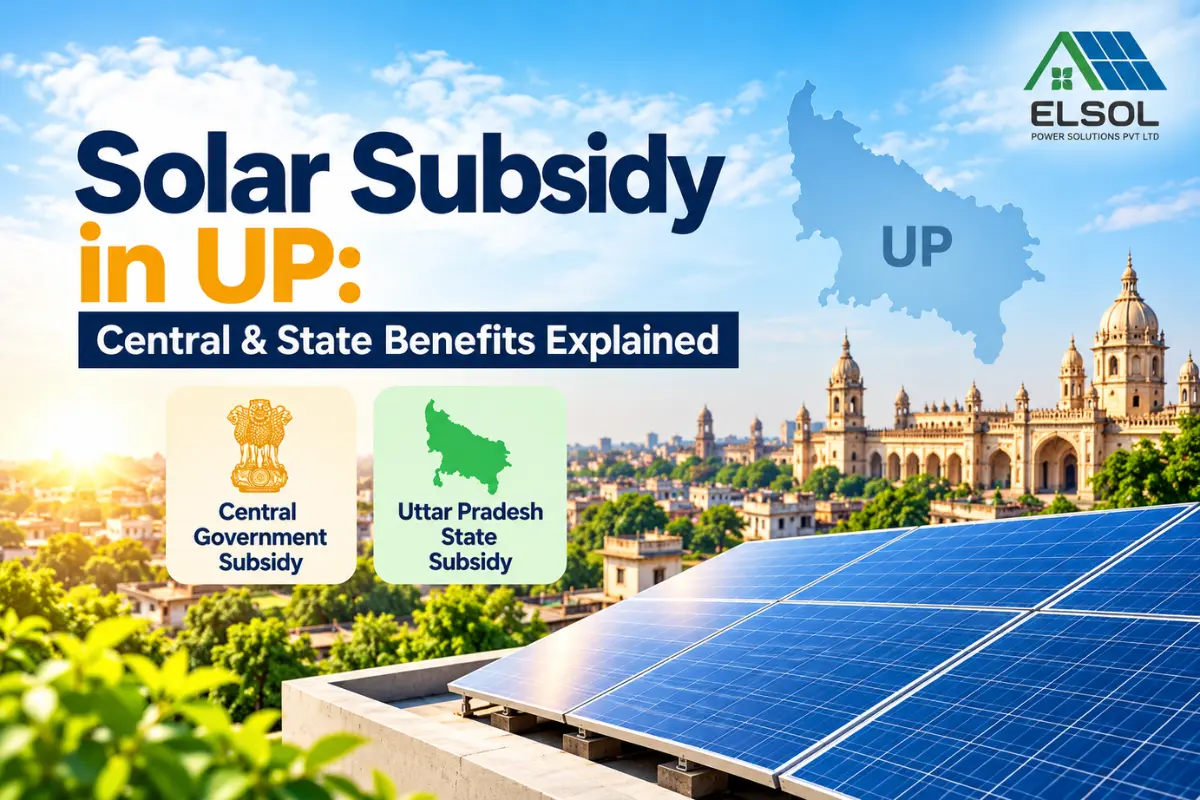
Solar Subsidy in UP: Central & State Benefits Explained


How much solar subsidy can you get in Uttar Pradesh? A residential rooftop solar owner in UP can claim a combined subsidy of up to ₹1,08,000, the central PM Surya Ghar subsidy of up to ₹78,000 plus the Uttar Pradesh state (UPNEDA) subsidy of up to ₹30,000. The exact figure depends on system size: ₹45,000 for 1 kW, ₹90,000 for 2 kW, and ₹1,08,000 for 3 kW and above. In practical terms this covers roughly half to two-thirds of the cost of a home solar system and, combined with net metering, brings the payback period down to about 4 to 6 years on a system that lasts 25 years.
Uttar Pradesh stacks a state subsidy on top of the national one, which makes it one of the most financially rewarding states in India for rooftop solar in 2026. This guide covers the complete picture: the exact amount by size, the percentage of your cost it covers, what your system actually costs after subsidy, how payback works, which of UP’s power distribution companies you fall under, how net metering is settled, whether off-grid and commercial systems qualify, the two-step application that trips most people up, and the mistakes that get subsidies rejected.
How Much Subsidy on Solar Panels in UP? (Quick Answer)
Uttar Pradesh gives you a two-layer subsidy, the national layer and the state layer, paid together for the same system:
| System Size | Central (PM Surya Ghar) | UP State (UPNEDA) | Total Subsidy |
|---|---|---|---|
| 1 kW | ₹30,000 | ₹15,000 | ₹45,000 |
| 2 kW | ₹60,000 | ₹30,000 | ₹90,000 |
| 3 kW and above | ₹78,000 | ₹30,000 | ₹1,08,000 |
The logic behind the numbers:
- The central subsidy is ₹30,000 per kW for the first 2 kW, plus ₹18,000 for the third kW, and is capped at ₹78,000 for any system of 3 kW or more.
- The UP state subsidy is ₹15,000 per kW, capped at ₹30,000, so it reaches its maximum at 2 kW.
A system of 3 kW or larger earns the full ₹1,08,000. Capacity beyond 3 kW adds no further subsidy, that extra is paid by you or financed, so for most homes 3 kW is the sweet spot that captures every rupee of support.
Solar Subsidy in UP as a Percentage of Your Cost
Homeowners often want the subsidy as a percentage rather than a flat figure, because that is what tells you how much of the bill the government is actually covering. Against typical 2026 installed prices in UP, the combined subsidy works out roughly like this:
| System Size | Approx. installed cost | Combined subsidy | Subsidy as % of cost |
|---|---|---|---|
| 1 kW | ₹60,000–75,000 | ₹45,000 | ~60–65% |
| 2 kW | ₹1.2–1.4 lakh | ₹90,000 | ~65–70% |
| 3 kW | ₹1.8–2.1 lakh | ₹1,08,000 | ~50–55% |
Smaller systems get back the highest percentage because the state subsidy caps at 2 kW. In every case the government is covering at least half of your system cost, which is why UP’s effective solar price is among the lowest in the country.
What a Solar System Actually Costs in UP After Subsidy
The subsidy only means something next to the real cost, so here is the before-and-after for the common residential sizes. A rooftop system in UP typically runs about ₹55,000 to ₹70,000 per kW installed, before subsidy, depending on panel type (DCR mono-PERC vs TOPCon), structure height, and vendor.
| System Size | Cost before subsidy | Combined subsidy | Net cost after subsidy |
|---|---|---|---|
| 1 kW | ₹60,000–75,000 | ₹45,000 | ₹15,000–30,000 |
| 2 kW | ₹1.2–1.4 lakh | ₹90,000 | ₹30,000–50,000 |
| 3 kW | ₹1.8–2.1 lakh | ₹1,08,000 | ₹72,000–1,02,000 |
| 5 kW | ₹3.0–3.5 lakh | ₹1,08,000 | ₹1.9–2.4 lakh |
Note how a 5 kW system gets the same ₹1.08 lakh as a 3 kW one, since the subsidy is capped, so the extra 2 kW is paid in full. Prices are indicative; always get a written, itemised quote for your exact figure.
Payback Period and Savings on Solar in UP
For most homeowners the real question behind “how much subsidy” is “when does this pay for itself.” With the UP subsidy plus net metering, the economics are strong:
- A 3 kW system generates roughly 12 units of electricity per day, around 360–400 units a month, enough to cover most of an average UP household’s consumption.
- At UP domestic tariffs, that typically saves on the order of ₹25,000 or more per year.
- Against a net cost of roughly ₹72,000–1,02,000 for a 3 kW system, that puts the payback period at about 4 to 6 years.
- Panels carry a performance warranty of around 25 years, so after payback you get roughly two decades of near-free electricity, worth several lakh rupees over the system’s life as tariffs keep rising.
Households that currently rely on a diesel or petrol generator during outages save even faster, because solar (especially a hybrid system) displaces expensive generator fuel on top of the grid savings.
Which UP DISCOM Are You Under? (It Affects Your Process)
Uttar Pradesh is served by five power distribution companies under UPPCL, and your net-metering approval, timelines, and local process depend on which one you fall under:
| DISCOM | Region | Major cities |
|---|---|---|
| PVVNL (Paschimanchal) | Western UP | Meerut, Ghaziabad, Noida, Moradabad |
| MVVNL (Madhyanchal) | Central UP | Lucknow, Bareilly, Sitapur |
| DVVNL (Dakshinanchal) | Southern UP | Agra, Aligarh, Jhansi |
| PuVVNL (Purvanchal) | Eastern UP | Varanasi, Gorakhpur, Azamgarh |
| KESCO | Kanpur city | Kanpur |
When you apply on the national portal you select your DISCOM, and that DISCOM is the body that issues technical feasibility approval, inspects your system, and installs the bidirectional net meter. Processing speed and net-metering backlog can vary between these zones, which is one reason an installer with local experience in your specific DISCOM area matters.
The Two-Layer Application: Why Many People Lose the State Subsidy
This is the single most important thing to get right in UP, and most generic guides skip it. The ₹78,000 central and ₹30,000 state subsidies come from two different bodies, the Government of India (through the PM Surya Ghar portal) and the UP government (through UPNEDA, the Uttar Pradesh New and Renewable Energy Development Agency). Your application has to satisfy both.
In practice the national rooftop solar portal is the primary entry point, and the UPNEDA state top-up is processed alongside it, but you must ensure the state registration is actually completed and your vendor is empanelled with UPNEDA, not just the national portal. Homeowners who complete only the central step sometimes receive the ₹78,000 and never see the ₹30,000. Confirm with your installer that both the central and the UPNEDA state claims are filed.
Net Metering in UP: How Your Surplus Earns Credit
Net metering is what turns your daytime surplus into money, and it is governed in UP by the UPERC (Uttar Pradesh Electricity Regulatory Commission) net-metering framework.
Here is how it works: a bidirectional (net) meter, installed by your DISCOM, records both the electricity you import from the grid and the surplus solar you export. When your panels produce more than you consume, the extra flows to the grid and is banked as credit, which is carried forward and settled within the billing/settlement year to offset the units you draw at night or on cloudy days.
Indicative tariffs that shape your savings:
- Export (buyback) rate: roughly ₹2.00 to ₹3.25 per unit, depending on your DISCOM
- Import (LMV-1 domestic) tariff: roughly ₹5.50 to ₹7.00 per unit
- Net-metering approval: typically around 60 to 90 days
Because you pay more to import than you earn to export, the smartest strategy is to use your solar directly during the day (run the pump, washing machine, and other heavy loads while the sun is up) and export only the genuine surplus. This “self-consumption first” approach captures far more value than relying on export credits.
On-Grid vs Hybrid Solar for UP’s Grid
An important UP-specific point: a standard on-grid system shuts down during a power cut (an anti-islanding safety feature), so it gives you savings but no backup. Given that many parts of UP still see frequent or long outages, a hybrid system (solar + battery + grid) keeps your essential loads running during a cut and lets you store daytime solar for the evening.
A hybrid system costs more upfront because of the battery, but in outage-prone areas it earns that back by displacing diesel-generator fuel and giving you reliable power. Both on-grid and hybrid configurations are eligible for the subsidy as long as they are grid-connected with net metering. The choice comes down to how reliable your local supply is and how much you value backup.
Does Off-Grid Solar Get a Subsidy in UP?
No. Pure off-grid (battery-only, non-grid-connected) systems do not qualify for either the PM Surya Ghar central subsidy or the UPNEDA state subsidy. Both schemes are built around grid-connected rooftop systems with net metering, because the subsidy model assumes you can export surplus to the grid.
If energy independence is your goal, a hybrid net-metered system is the better route than going fully off-grid: you still get battery backup, but you also keep the full ₹1.08 lakh subsidy and the net-metering credits. A fully off-grid setup sacrifices all of that support. (Farmers are the exception, through a separate scheme covered below.)
Subsidy for Commercial, Institutional and Farm Solar in UP
The residential subsidy does not apply to businesses, but UP’s solar support does not stop at homes:
- Commercial and industrial (C&I) buildings are not eligible for the PM Surya Ghar residential CFA. Instead, businesses benefit from net metering, accelerated depreciation (a major income-tax benefit on the system cost), and lower long-term energy costs, which keep commercial rooftop solar attractive even without a direct subsidy.
- Farmers have their own dedicated scheme, PM-KUSUM, which subsidises solar water pumps heavily, typically with central and state assistance covering a large share of the cost and the farmer paying a small percentage. This is administered in UP through UPNEDA’s KUSUM process and is separate from the rooftop scheme.
Eligibility Criteria for Solar Subsidy in UP
To claim the combined residential subsidy, you need to meet all of these:
- You are a residential electricity consumer with a valid, grid-connected UP connection (under PVVNL, MVVNL, DVVNL, PuVVNL, or KESCO)
- Your proposed system size fits within your sanctioned load, a 3 kW system generally needs a sanctioned load of at least 3 kW, so you may need a load enhancement first
- Installation is done by a vendor empanelled on both the national portal and with UPNEDA
- Panels are ALMM-listed, Made-in-India (DCR) modules
- Your rooftop has shadow-free space, roughly 100 sq. ft. per kW
- No prior subsidy has been claimed on the same electricity connection
Documents Required
- Aadhaar card
- Latest electricity bill (showing consumer number and sanctioned load)
- Property ownership proof, or landlord NOC if rented
- Bank account details / cancelled cheque (for the DBT transfer)
- Passport-size photograph (for some DISCOM/UPNEDA steps)
Make sure the name on your Aadhaar, electricity bill, and bank account match, a mismatch is one of the most common causes of subsidy delay.
How to Apply for Solar Subsidy in UP: Step by Step
- Check your sanctioned load and DISCOM. Confirm your connection’s sanctioned load supports your intended system size, and note which DISCOM you fall under.
- Register on the national portal at pmsuryaghar.gov.in, selecting Uttar Pradesh and your DISCOM, and enter your consumer number and desired capacity.
- Choose an empanelled vendor listed on both the national portal and with UPNEDA, so your state subsidy is protected.
- Get technical feasibility approval from your DISCOM before any installation begins.
- Install the system using ALMM-listed DCR panels.
- Apply for net metering and inspection; the DISCOM inspects, commissions the system, and installs the bidirectional meter.
- Receive the subsidy by Direct Benefit Transfer into your bank account, typically within about 4 to 6 weeks of commissioning, with the central and state shares settled per the respective schemes.
Common Reasons the UP Solar Subsidy Gets Delayed or Rejected
Avoiding these keeps your ₹1.08 lakh on track:
- Installing before feasibility approval. Any work started before the DISCOM’s go-ahead can disqualify the subsidy.
- Vendor not empanelled on both portals. A vendor on the national portal but not with UPNEDA can cost you the state share.
- Aadhaar–bank–bill name mismatch. DBT fails if the names do not match.
- Skipping the UPNEDA state application. The most common way UP homeowners lose the ₹30,000.
- Insufficient sanctioned load. Your system size cannot exceed your sanctioned load without an enhancement.
- Non-ALMM or non-DCR panels. Only approved, Made-in-India modules qualify.
UP-Specific Factors That Affect Your Solar Returns
A few local realities shape how well solar performs in Uttar Pradesh:
- Voltage fluctuation. Parts of UP see wide voltage swings, so a good installer specifies an inverter with a wide operating tolerance to protect generation and equipment.
- Regional sunlight. Peak sun hours vary slightly across western, central, and eastern UP, which affects annual generation and is factored into correct system sizing.
- Fixed monthly charges remain. Net metering offsets your energy (per-unit) charges, but the fixed/demand charges on your connection continue, so your bill rarely hits exactly zero.
- Generator displacement. In outage-prone areas, the value of avoided diesel is often as large as the grid savings, which is what makes hybrid systems pay back quickly there.
Why 2026 Is a Strong Time to Go Solar in UP
Several factors line up this year: domestic electricity tariffs keep climbing, the combined central-plus-state subsidy is at its most generous, DCR panel prices have fallen, and UP is adding rooftop capacity rapidly under the PM Surya Ghar push. The central scheme is funded through FY 2026-27, and subsidy capacity is allotted as applications are processed, so applying sooner both starts your savings earlier and secures your subsidy slot before local demand tightens.
Conclusion
Uttar Pradesh offers one of the most attractive solar subsidy structures in India. Between the central PM Surya Ghar subsidy of up to ₹78,000 and the UPNEDA state top-up of up to ₹30,000, an eligible homeowner can claim up to ₹1,08,000, covering roughly half to two-thirds of the cost of a rooftop system that then pays for itself in about 4 to 6 years and runs for 25. The catch is that the state share is easy to lose if the UPNEDA step, the right DISCOM process, or the ALMM and sanctioned-load requirements are not handled correctly.
That is where the installer makes the difference. El Sol Power Solutions Pvt Ltd, a trusted and experienced solar company in Uttar Pradesh, manages the complete journey, system design, DISCOM feasibility, installation with ALMM-listed panels, net metering, and both the central and UPNEDA subsidy claims, through an in-house team of experts, with 9+ years of experience, 8,000+ customers, and 20 MW of rooftop solar installed across India. If you want your full UP solar subsidy claimed correctly the first time, request a consultation with El Sol Power Solutions at elsol.co.in.
Frequently Asked Questions
1. How much subsidy do you get on solar panels in UP?
Up to ₹1,08,000 combined for a residential rooftop system, ₹78,000 from the central PM Surya Ghar scheme plus ₹30,000 from the UP state (UPNEDA) scheme. By size it is ₹45,000 for 1 kW, ₹90,000 for 2 kW, and ₹1,08,000 for 3 kW and above.
2. What percentage of the cost does the solar subsidy cover in UP?
Roughly 50% to 65% of a residential system’s cost. Smaller 1–2 kW systems recover the highest percentage (around 60–70%) because the state subsidy caps at 2 kW, while a 3 kW system is typically around 50–55%.
3. How much is the UP state (UPNEDA) subsidy on solar panels?
₹15,000 per kW, capped at ₹30,000, reaching the cap at a 2 kW system. It is paid in addition to the central PM Surya Ghar subsidy, which is what gives UP its combined ₹1.08 lakh total.
4. What will a solar system cost me after subsidy in UP?
Indicatively, a 1 kW system nets around ₹15,000–30,000, a 2 kW around ₹30,000–50,000, and a 3 kW around ₹72,000–1,02,000 after the combined subsidy. A 5 kW system nets roughly ₹1.9–2.4 lakh, since the subsidy is capped at the 3 kW level.
5. What is the payback period for rooftop solar in UP?
About 4 to 6 years for a typical residential system after subsidy and net-metering savings. A 3 kW system saves roughly ₹25,000 or more a year, and the panels last around 25 years, so most of the system’s life is effectively free power.
6. Is there a subsidy for off-grid solar systems in UP?
No. Both the central and UPNEDA subsidies require a grid-connected, net-metered system. Pure off-grid (battery-only) setups are not eligible. If you want backup, choose a hybrid net-metered system, which keeps the subsidy.
7. Is solar subsidy available for commercial buildings in UP?
Not the residential CFA. Commercial and industrial buildings instead benefit from net metering and accelerated depreciation tax savings. Farmers have a separate scheme, PM-KUSUM, for subsidised solar pumps.
8. Do I need to apply separately to UPNEDA for the state subsidy?
Effectively yes, the state top-up is handled through UPNEDA alongside the national portal, and your vendor must be empanelled with UPNEDA. Completing only the central application is the most common reason UP homeowners miss the ₹30,000 state share.
9. Which DISCOM handles my solar connection in UP?
One of five: PVVNL (western UP), MVVNL (central UP, including Lucknow), DVVNL (southern UP), PuVVNL (eastern UP), or KESCO (Kanpur). Your DISCOM issues feasibility approval, inspects the system, and installs the net meter.
10. How long does it take to receive the subsidy in UP?
Typically about 4 to 6 weeks after your system is installed, inspected, and commissioned with a net meter, credited to your bank account by Direct Benefit Transfer.
11. Can I sell extra solar power to the grid in UP?
Yes, through net metering under the UPERC framework. Surplus is exported and banked as credit at roughly ₹2.00–3.25 per unit depending on your DISCOM, carried forward within the settlement year to offset future bills.