

How to Verify Your Installer Is MNRE-Empanelled (Before You Pay)
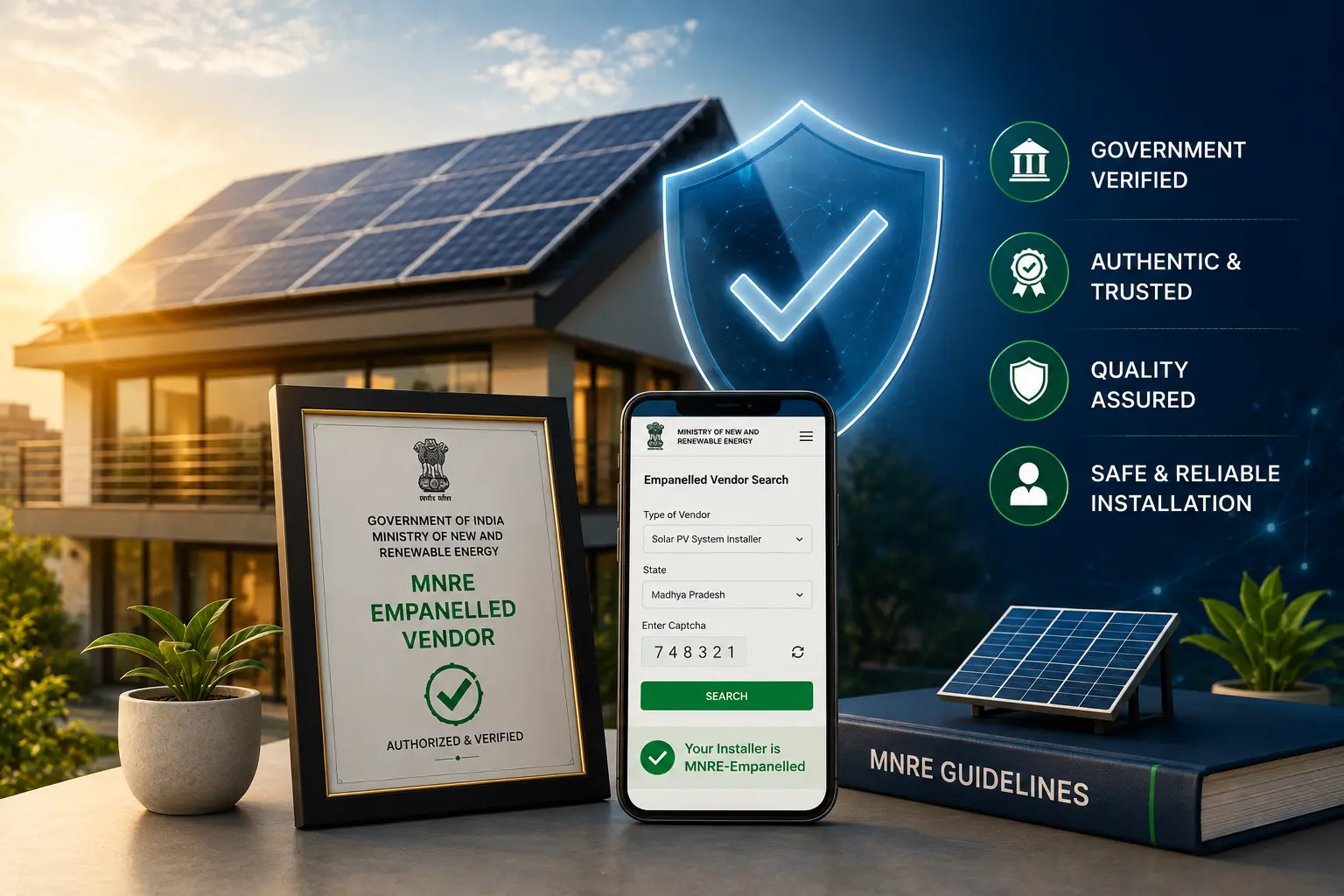


To verify that your solar installer is MNRE-empanelled before you pay, go to the official portal at pmsuryaghar.gov.in, open the vendor list, select your state and DISCOM, and confirm the company appears with an active empanelment status. Then separately check that the exact panel brand and model they have quoted appears on the ALMM (Approved List of Models and Manufacturers) list on mnre.gov.in. Both checks matter, because your PM Surya Ghar subsidy of up to ₹78,000 is only released if your installer is empanelled with your DISCOM and your panels are ALMM-listed. If either box is unticked, the subsidy is not paid, no matter how good the pitch or the paperwork looked.
This five-minute verification is the single most important thing you can do before spending a rupee on rooftop solar. Here is exactly how to do it, the fake “approvals” fraudsters flash, and the documents a genuine installer will hand over without hesitation.
Why This Check Matters So Much
Solar fraud in India is real and rising, precisely because PM Surya Ghar is pulling millions of homeowners toward rooftop solar and every kind of operator is showing up to cash in. Scams rarely look like scams. They look like a friendly agent with a laptop full of “government-approved” documents and a confident promise of a “guaranteed subsidy.” Most people who lose money never asked the one question that separates a legitimate vendor from a fraud: is this company actually on the MNRE portal and empanelled for the scheme?
There are two separate things you must confirm, and they are not the same:
- Installer empanelment. Your installer must be registered on the PM Surya Ghar national portal and empanelled by your state DISCOM. Only empanelled vendors can carry out installations that qualify for central financial assistance.
- ALMM-listed equipment. Your panels must appear on MNRE’s ALMM list. Only ALMM-listed, BIS-certified modules are eligible for a subsidised system.
A vendor can be genuine on one count and fail the other. Both need a green tick before you sign.
Step-by-Step: How to Verify Your Installer
Step 1: Check the official PM Surya Ghar vendor list. Go to pmsuryaghar.gov.in, the only official national portal for the scheme. Find the vendor-list section, select your state, then select your DISCOM. Browse or download the district-wise list for your city. You will see the vendor’s name, registration ID, empanelment status, and contact details. Cross-check these against what the company has told you; the name on the portal must match the name on your quotation.
Step 2: Verify the panels and inverter on the ALMM list. Ask your installer for the exact brand, model, and wattage of the panels they intend to fit. Then open the ALMM section on mnre.gov.in, find the latest ALMM List-I, and search for that manufacturer and model. If the panels are not on the list, they will not qualify for subsidy, and any installer telling you otherwise is misleading you.
Step 3: Confirm the empanelment is active, not expired or blacklisted. Vendor status changes over time. Make sure the listing shows a current, active status. If a company has been suspended or blacklisted by MNRE or the DISCOM for non-compliance, that should be reflected on the portal, so a name that once appeared is not enough; it must be active today.
Step 4: Use the DCR verification portal for an extra layer. For Made-in-India (DCR) compliance, MNRE has a dedicated DCR Verification Portal developed by NISE (National Institute of Solar Energy). This lets you confirm whether specific modules are genuinely domestically manufactured and ALMM-compliant, which matters because DCR compliance is required for the residential subsidy.
Step 5: Ask for the paperwork before signing anything. A legitimate, empanelled installer will produce the following without hesitation:
- DISCOM empanelment letter, proving official registration
- State nodal agency vendor registration number, proving state-level authorisation
- GST registration certificate and company PAN, proving a real business entity
- BIS certification for the panels, proving they meet quality standards
- A sample work order or net-metering document, proving they have done this before
If a vendor hesitates, gives vague answers, or claims none of this is needed, treat that as your answer and walk away.
Red Flags That Signal a Scam
Some warning signs are universal, and any one of them is reason to stop:
- “Free solar panels” or “zero-cost installation.” No government scheme installs panels for free. The subsidy of up to ₹78,000 is credited to your bank account after installation and verification, never upfront and never through a middleman.
- Large advance payment demanded. Legitimate solar panel installers work on a milestone-based payment structure. Anyone demanding the full cost or a very large advance before work begins is a red flag.
- No physical office or verifiable address. A genuine solar company in india has an operational presence you can visit. A mobile number and a WhatsApp profile are not enough.
- Pressure to sign “before the scheme ends.” This is a manufactured-urgency tactic. Scheme timelines are posted publicly on the portal; no vendor has secret deadline information.
- No brand name or BIS mark on equipment. If an installer cannot name the panel brand, or dismisses BIS certification as unnecessary for homes, they are either lying or using substandard equipment.
- A “subsidy processing fee.” The subsidy reaches you directly by DBT after your DISCOM verifies the installation. No fee, agent charge, or middleman payment is ever legitimate.
What to Do If You Have Been Defrauded
If you have already paid a suspicious vendor or suspect a scam, act quickly:
- Gather evidence: payment receipts, contracts, and all WhatsApp or email chats.
- Check the portal first to confirm whether the vendor was ever actually empanelled.
- Raise a grievance in the support section of pmsuryaghar.gov.in.
- Report the vendor to your local DISCOM, especially if installation or net metering was involved.
- File a consumer complaint via the National Consumer Helpline (1915).
- For digital-payment fraud, call the cyber-crime helpline (1930) or file at cybercrime.gov.in.
- For a significant loss, lodge a police FIR and notify MNRE if the vendor falsely claimed government empanelment.
The Right Way to Go Solar
Done through the right channel, going solar remains one of the smartest financial decisions a homeowner can make. The legitimate path is simple:
- Register on pmsuryaghar.gov.in with your electricity consumer number and Aadhaar details.
- Wait for eligibility confirmation from your DISCOM.
- Choose an installer from the official portal list; ideally do not engage anyone who approached you first.
- Get a site survey and a written contract, not just a WhatsApp quote.
- Let the vendor handle installation and the net-metering application.
- After post-installation inspection, your subsidy is credited directly to your bank account, with no fees involved.
Solar is at least a 25-year investment. Spending five minutes verifying before you spend a single rupee is the cheapest insurance you will ever buy.
Choosing a Verified Installer You Can Trust
Verification protects your money, but it also points you toward installers who do the whole job properly, since the same companies that clear empanelment usually also handle net metering, subsidy filing, and warranty support without leaving you to chase paperwork alone. When you shortlist a solar company in india, confirm empanelment first, then judge them on transparency: a trustworthy installer volunteers documents, names panel brands, and follows a milestone payment structure rather than demanding cash upfront.
El Sol Power Solutions Pvt Ltd is a registered solar company with 9+ years of rooftop solar experience, 8,000+ customers, and 20 MW of installations across India, and it manages the entire journey, from portal registration and ALMM-compliant system design to net metering and following the ₹78,000 subsidy through until it reaches your account. If you want an empanelled installer who handles the verification and paperwork for you, get a free consultation at elsol.co.in, and of course, verify the listing yourself on the official portal first.
Frequently Asked Questions
1. Can I get the PM Surya Ghar subsidy if I use an unregistered installer?
No. The subsidy of up to ₹78,000 is only released after your DISCOM verifies the installation. If your installer is not empanelled with your DISCOM, the installation will not be approved and your subsidy will not go through. Always choose from the official PM Surya Ghar vendor list before any work begins.
2. How do I verify MNRE empanelment for a rooftop solar installer?
Visit pmsuryaghar.gov.in, open the vendor list, select your state and DISCOM, and confirm the company appears with an active status. Then check the quoted panels against the ALMM list on mnre.gov.in. This is the core of how you verify MNRE empanelled installer credentials before paying.
3. Is it safe to pay a solar installer in advance?
Partial advances are normal, but be cautious of anyone asking for the full amount upfront. Genuine solar panel installers follow a milestone-based structure, a portion at booking and the rest at installation. Never pay a large cash lump sum, and always get a written agreement.
4. How long does the subsidy take to reach my account?
The subsidy is credited directly by DBT after your DISCOM inspects the installation and the net meter is activated. In practice this is often completed within about 30 days.
5. Can an installer register on the PM Surya Ghar portal on their own?
No. A vendor cannot self-register and instantly appear as approved. They must apply to their DISCOM, submit documents and a Performance Bank Guarantee, and be approved before their details are uploaded to the national portal. This is why the portal listing is a reliable check.
6. Does using a large solar company in india guarantee my subsidy?
Size alone does not; empanelment and ALMM-compliant equipment do. Always confirm the specific company is on your DISCOM’s list and that the exact panels quoted are ALMM-listed, regardless of how well known the rooftop solar brand is.


